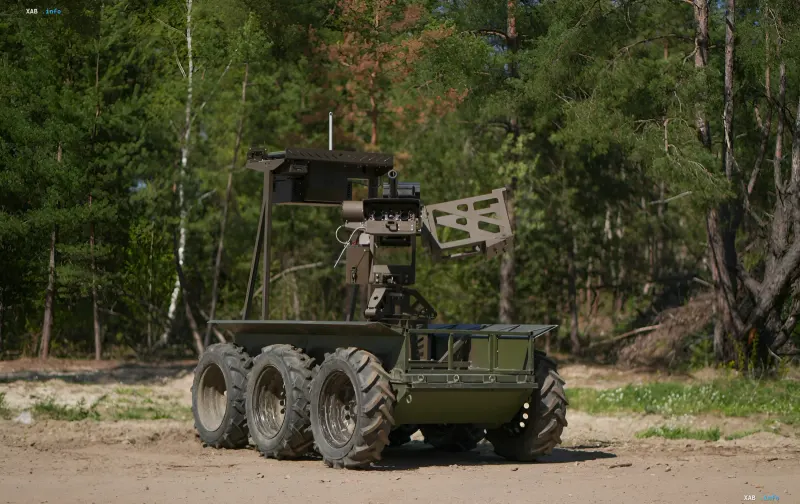
At the international MSPO 2026 defense exhibition, Ukrainian company DevDroid presented the Droid TW 40 — a reconnaissance-strike ground robotic complex (GRC) armed with an automatic 40mm grenade launcher. The new machine is designed to carry out combat missions at a distance and provide fire support to units without the direct presence of personnel in the engagement zone, thereby reducing risks for crews on the front line.
Combat Module and Fire Capabilities
The key element of the Droid TW 40 is the 40mm automatic grenade launcher, which allows the complex to engage targets from both open and covered firing positions. The stated range of fire reaches 1.5 km, giving operators the ability to strike targets at significant distance while remaining outside the enemy's effective range of fire. This approach is characteristic of the modern doctrine of ground robotics deployment, in which the robot acts as an autonomous firing point.
Targeting and Detection
To improve accuracy and the speed of mission execution, the complex is equipped with a built-in ballistic computer and a coordinate-based targeting system. Additionally, a thermal imager is installed on the combat module, providing target detection and tracking under line-of-sight conditions, including at night and in limited visibility. The combination of ballistic calculations and a thermal targeting channel increases the probability of a hit and reduces the operator's reaction time.
Mobility and Autonomy
According to the manufacturer, the maximum speed of the Droid TW 40 is up to 13 km/h. The range reaches up to 70 km on paved roads and up to 50 km off-road. In standby mode, the complex can operate without moving for up to 120 hours, allowing it to be used for prolonged holding of firing positions and observation of a sector of responsibility.
Communications and Control
The Droid TW 40 platform supports up to six types of communication channels, including radio, LTE, and satellite communications, ensuring reliable control under various electronic warfare conditions. The operator controls the platform and combat module through a single interface, which simplifies interaction and reduces the workload on the crew during mission execution.
Context: The Growing Use of GRCs in 2026
The presentation of the Droid TW 40 comes against the backdrop of a sharp expansion of the role of ground robotics in combat operations. As RBC-Ukraine previously reported, the number of GRC missions has increased 3.3-fold since the beginning of 2026, and in August alone the robots completed more than 25,000 logistical and evacuation tasks on the front line. Meanwhile, the volume of GRC contracts since the start of the year has nearly doubled compared to the previous year, indicating a systematic increase in procurement and the integration of robotic complexes into the armed forces' structure.