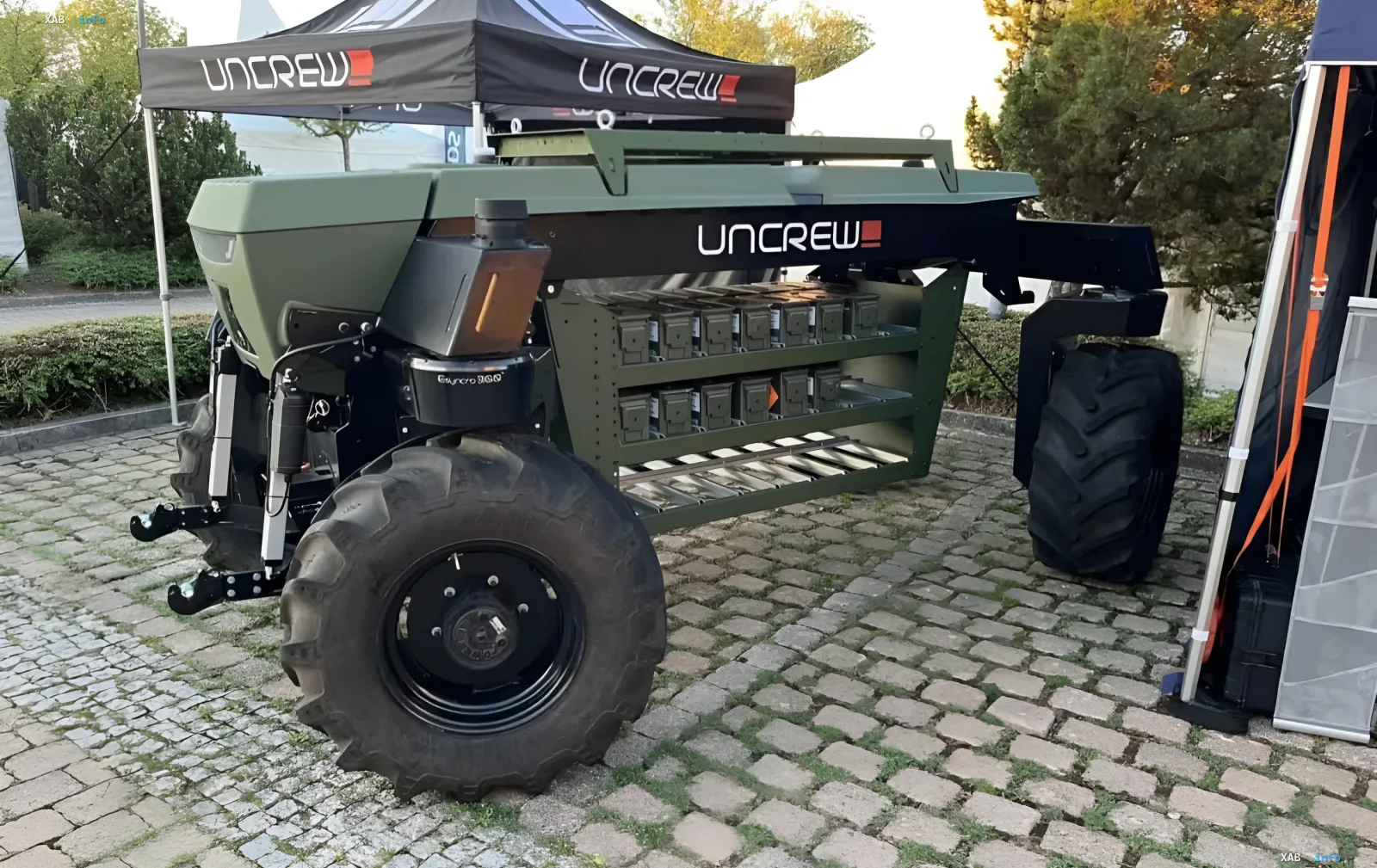
Norwegian company Uncrew Robotics AS has unveiled the Uncrew IC 12 Defence ground robotic complex (GRC), designed for logistics and engineering tasks in the military sphere. According to Hartpunkt, cited by RBC-Ukraine, the platform was premiered at the 10th KSK (Kommando Spezialkräfte) symposium, dedicated to armaments. The platform, as the manufacturer states, has already been adopted by the Norwegian armed forces and was developed based on agricultural machinery, which explains its high cross-country capability and structural reliability in field conditions.
Design and Maneuverability
The key feature of the Uncrew IC 12 Defence is that each of its four wheels is steerable and equipped with a separate electric drive. Thanks to this configuration, the robot, much like tracked vehicles, is capable of pivoting in place and moving sideways, which is critical for maneuvering in confined spaces. The unit can be controlled in three modes: remote, semi-autonomous, and fully autonomous, allowing it to be flexibly adapted to a specific task and the operator's level of training.
Human-Free Logistics: Pallets and Cargo
A fork system built into the body allows the robot to autonomously lift, transport, and lower Euro pallets weighing about a ton without the involvement of personnel, which, according to the manufacturer, makes full automation of ammunition transport possible. In addition, the unit can carry up to 1.2 tons of cargo "under suspension": in this mode, transport and unloading are performed autonomously, while loading requires external assistance. The platform's total payload capacity reaches two tons — both cargo and various tools.
Engineering Functions and Use in Norway
A standard hydraulic interface at the front of the body allows for the installation of interchangeable equipment sets — shovels, brushes, or forks — for earthworks and material handling. In Norway, according to the manufacturer, the robot is used, among other things, to clear the runways of military airfields. At the KSK symposium, the complex was demonstrated in an ammunition transporter configuration without a tool set, although the manufacturer also states that the platform can be used as a sensor carrier.
Contradictory Data
Several figures on payload capacity appear in open materials: "up to two tons of payload," "up to 1.2 tons under suspension," and "pallets of about a ton." At first glance, this looks like an inconsistency, but in fact it refers to different operating modes rather than a contradiction: two tons is the total payload capacity (including tools), 1.2 tons is the autonomous transport and unloading mode "under suspension," and about a ton is the weight of the Euro pallet that the fork system lifts fully autonomously. Different sources (RBC-Ukraine and 24tv) report the same parameters, and no significant discrepancies in dates or specifications have been recorded between them.
Context for Ukraine
The issue of logistics using ground robotic complexes remains one of the key ones for the Ukrainian army. As RBC-Ukraine previously noted, in August the KILLHOUSE Academy GRC School received the heavy Protector complex. According to the school's founder, Viktor Pavlov, the tactics of employing such GRCs are built precisely around logistics: the complex delivers significant volumes of cargo to intermediate resupply points, from where smaller GRCs distribute it directly to the positions. The Norwegian Uncrew IC 12 Defence demonstrates a similar philosophy — automating resupply and unloading without human involvement in the danger zone.