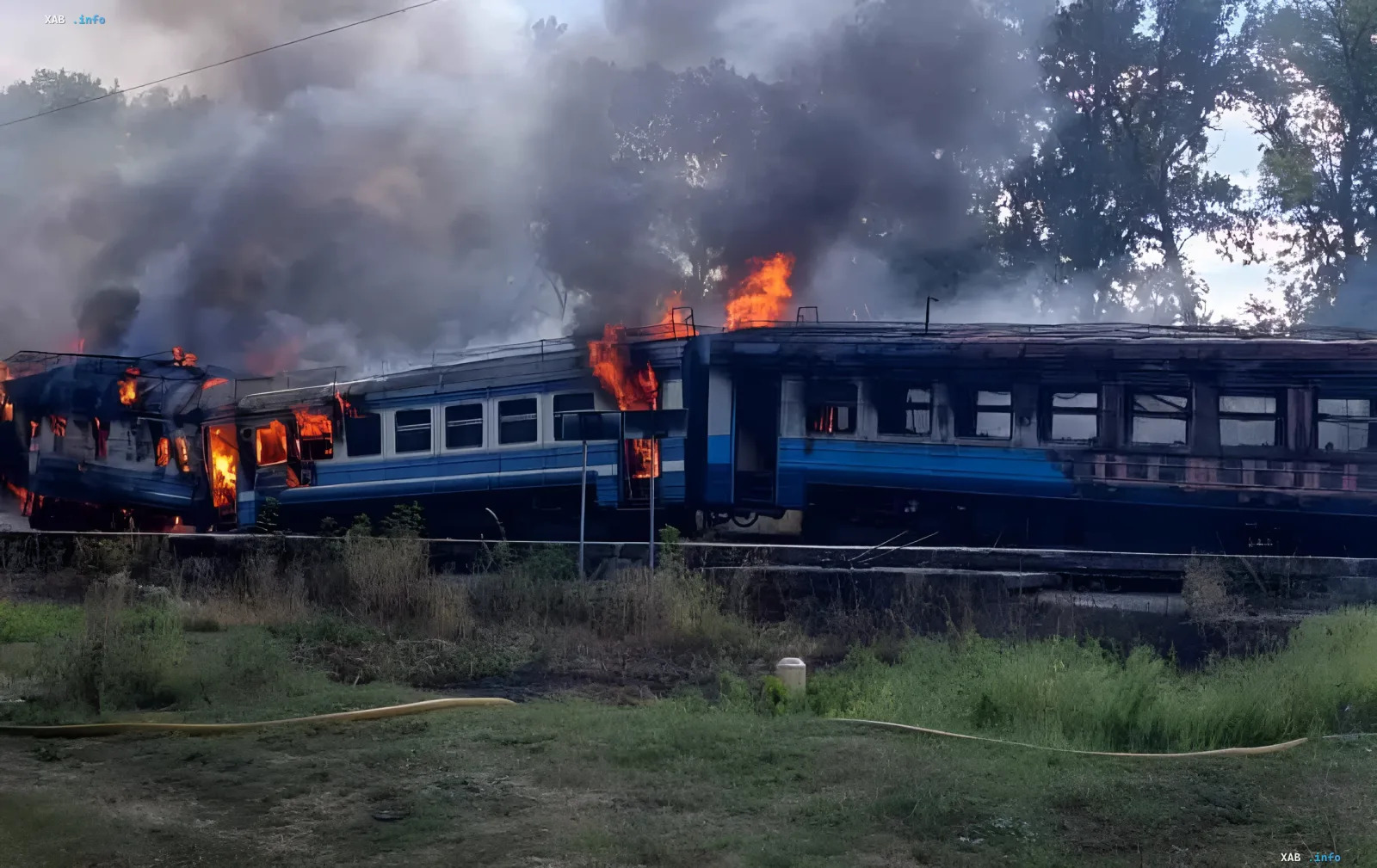
Russia has shifted to deliberate strikes on Ukrainian passenger trains using jet-powered drones operating on mesh networks. This is reported by RBC-Ukraine, citing a publication by Politico. According to the source, since the start of Russia's full-scale invasion, it has damaged or destroyed more than 500 UZ (Ukrzaliznytsia) locomotives, with more than 60% of these losses occurring in the last eight months. Ukrainian railways are currently losing between 37 and 40 locomotives per month. Against the backdrop of ongoing attacks, Kyiv emphasizes that the consequences of the strikes go far beyond military logistics.
Scale of Losses and Kyiv's Official Position
In Russia, strikes on railway infrastructure are officially framed as part of a strategy against Ukrainian logistics, particularly that used to deliver foreign weapons. UZ rejects this interpretation. "The Russians are trying to isolate our frontline communities, sow panic and fear among already exhausted local residents, and paralyze the economy," stated Oleksandr Pertsovskyi, Chairman of the Board of JSC "Ukrzaliznytsia." According to him, since autumn 2025, Russian forces have begun deliberately targeting passenger trains after obtaining antennas for mesh networks — a technology that allows drones to maintain communication with each other and with ground transmitters, including on the territory of Belarus or occupied areas of Ukraine.
New Tactics: Mesh Networks and the Expansion of Strike Geography
As Pertsovskyi notes, last autumn Russian drones struck a train near Lozova in Kharkiv Oblast, killing six people. Following this, UZ introduced evacuation protocols that, according to the company's head, allow most passengers to be saved. The majority of attacks fall on areas within 200 kilometers of the contact line, however, the geography of drone use has recently expanded: "Now the Russians are using antennas and repeaters in Belarus to strike western regions of Ukraine as well," Pertsovskyi explained.
Strikes Near the Polish Border and the Risk to Foreigners
Politico separately mentioned a recent attack near the Polish border: a Russian drone hit a train shortly after another consist had departed, which carried European security advisers and former leaders, including former UK Prime Minister Boris Johnson. UZ speculated that the target may have been that very train, since it departed earlier than scheduled. "The recent strikes near the Polish border indicate that an additional objective is to raise the risks for our foreign guests, partners, diplomats, politicians, and journalists," Pertsovskyi stated. Yulia Chikolba, Director of the Center for Information Resilience in Ukraine, who was traveling from Kyiv to Hrubieszów in Poland on the day of the attack, said that passengers were evacuated twice and the train was delayed by seven hours.
Contradictory Data
Some details are published citing statements from UZ and are not confirmed by independent third-party fact-checking. In particular, the version that the target of the strike near the Polish border was the train carrying Boris Johnson is an assumption by the Ukrainian side, not an established fact; Russia's intentions in this episode have not been officially confirmed. Similarly, the exact monthly losses (37–40 locomotives) and the overall figure of "more than 500" are cited as estimates by UZ/Politico and may vary depending on the methodology for accounting damaged versus completely destroyed equipment. Various Ukrainian outlets (RBC-Ukraine, Glavred, Gordonua, Dialog) relay the same figures without significant discrepancies, however, independent verification of the scale of losses at the locomotive level in open sources is not yet available.
Recovery Economics and the Gauge Problem
The attacks create not only a threat to passengers but also a serious problem for the recovery of rolling stock: the cost of a single new locomotive is about 5 million euros. "Repairing locomotives is a key priority: spare parts, materials, and personnel capable of conducting repairs around the clock. We have reliable partners — the European Bank for Reconstruction and Development and the World Bank, but the rate of destruction is so high that our financial resources are insufficient," said Pertsovskyi. It is difficult to quickly replace equipment through foreign aid due to the difference in track gauge: Ukraine uses 1520 mm, while the standard for most of Europe is 1435 mm. The Baltic states and Finland have the same gauge as Ukraine; Lithuania has already pledged to transfer locomotives as part of the winter aid package. Despite the losses, UZ continues to plan operations under various scenarios, balancing passenger safety with the need to maintain transport connectivity.