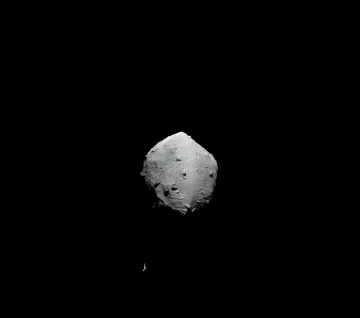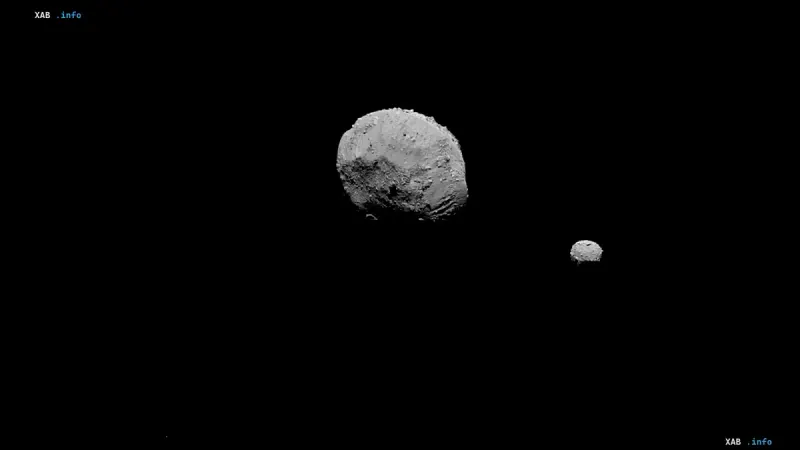
The European Space Agency (ESA) has unveiled detailed images of the asteroid Dimorphos, obtained during the ongoing mission of the Hera spacecraft. The images, released on November 26, 2026, allow scientists for the first time to study in high resolution the consequences of the directed collision that occurred in September 2022. The frames clearly show a colossal crater formed as a result of the NASA experiment, during which the DART research probe was intentionally directed at the celestial body.
Scale of the planetary experiment
The impact surface of Dimorphos, which absorbed the primary impulse from the DART probe, has undergone significant changes. Analysis of the images shows that a flattened crater, comparable in dimensions to a professional sports stadium, has emerged at the impact site. This deformation is key evidence of the success of the first test in human history of planetary defense technologies.
Motion dynamics and orbital changes
The Hera mission continues to track Dimorphos's behavior as it orbits the larger asteroid Didymos. Experts note that the small asteroid exhibits unstable rotation, tumbling in its orbit. Periodically, the object passes through the shadow of its companion, allowing Hera's instruments to collect additional data on the structure and composition of the surface, which was altered by a powerful external impact.
Significance for Earth's protection
According to preliminary reports, the 2022 collision had a significant impact on the system's dynamics. The DART probe's impact led to a reduction in Dimorphos's orbital period around Didymos by approximately 33 minutes. These data are of fundamental importance for the development of systems to prevent threats from potentially hazardous near-Earth objects, allowing astrophysicists to model the impact of kinetic strikes to alter asteroid trajectories.
Prospects for the Hera mission
The Hera research spacecraft continues to carry out tasks for the detailed inspection of the asteroid pair. The obtained data will form the basis for long-term analysis of how the geology of small celestial bodies changes under the influence of anthropogenic factors. Further observation will help scientists better understand the composition of Dimorphos and the effectiveness of the chosen planetary defense strategy in real space conditions.