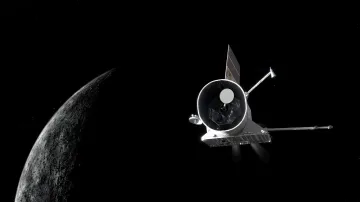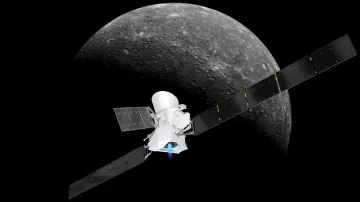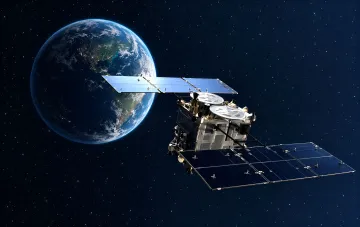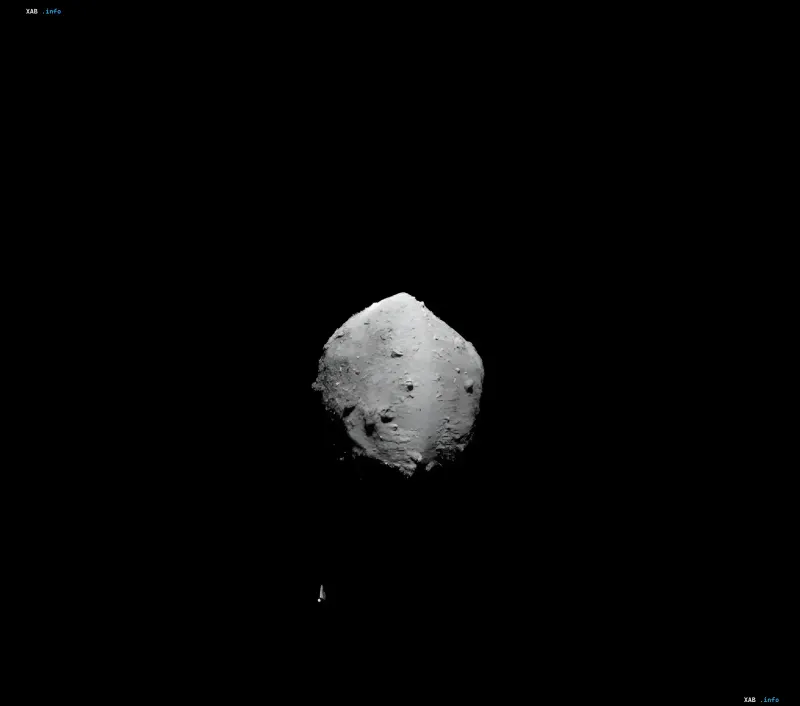
The Japan Aerospace Exploration Agency (JAXA) has published the first thermal images of the Didymos–Dimorphos binary asteroid system. The images were captured by the TIRI infrared camera aboard the European space probe Hera. It was on these very objects that NASA carried out the DART experiment in 2022: the probe deliberately collided with the smaller body of the system, Dimorphos, to test whether the orbit of a celestial body could be altered by a kinetic impact. Now the Hera mission must examine the consequences of that collision in detail, and the infrared imaging provides access to surface properties that cannot be assessed in the ordinary optical range.
How the images were taken: 57 kilometres and the infrared range
According to JAXA, the TIRI images were obtained on 31 October from a distance of about 57 kilometres from the binary system. The camera records thermal radiation in the 8–14 µm wavelength range, so the brightness of each pixel depends directly on the surface temperature of the asteroid. The fundamental difference from optical cameras is that TIRI does not require reflected sunlight: it is able to observe even areas lying in shadow. This allows scientists to track how the surface cools after sunset and to obtain data on the dark side of the bodies, which is inaccessible to ordinary imaging systems.
Thermal inertia as the key to surface composition
From the dynamics of temperature change, researchers will be able to assess the thermal inertia of the asteroids — the ability of the material to heat up and cool down. This parameter serves as an indicator of the physical properties of the surface: in particular, its porosity and the predominant type of material — fine-grained regolith or large rocks. In the first published frames, Dimorphos appears colder than Didymos. JAXA explains this by the fact that part of the small satellite was in the shadow of the larger asteroid at the time of imaging, rather than by any fundamental difference in the composition of its surface.
Observing the passage through the shadow
Particular scientific importance is attached to observations of the moment when Dimorphos passes through the shadow of Didymos: the camera recorded a drop in its temperature during this period. According to the Japanese mission team, such measurements will allow the surface characteristics to be refined and the physical consequences of the DART collision to be assessed. The data obtained will complement the information provided by the optical cameras of Hera, which record reflected sunlight but are unable to directly measure temperature changes on the dark side of the asteroid.
What comes next: closing in to 20–30 kilometres
The European Space Agency (ESA), which is leading the Hera mission, plans to bring the spacecraft to within 20–30 kilometres of the asteroids for detailed scientific observations. In this way, the DART experiment, which for the first time demonstrated the possibility of changing the motion of a celestial body by collision, will receive a logical continuation: Hera will study the very system after the impact and help determine which specific properties of the asteroid influence the outcome of such an intervention. This is important for refining planetary defence technologies in the event of real threats from potentially hazardous objects.