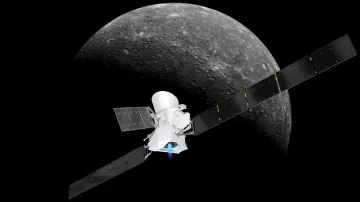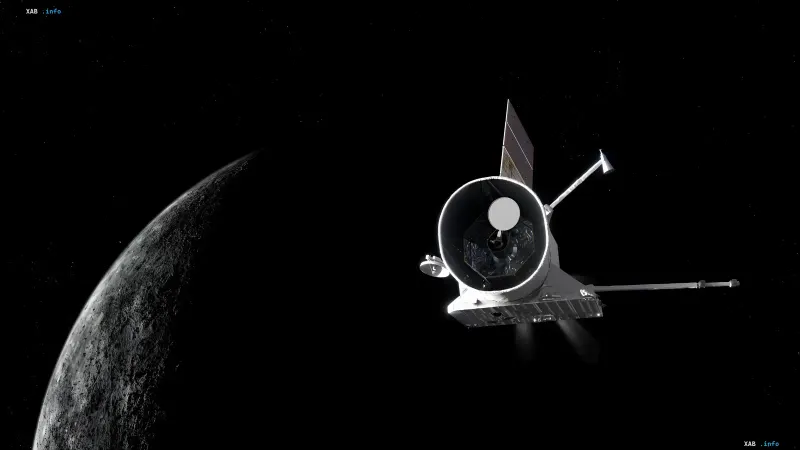
On November 21, 2026, the European-Japanese BepiColombo mission successfully entered Mercury's orbit despite a glitch during a crucial braking maneuver. The spacecraft's thrusters were scheduled to fire for 37 minutes, but the automated system prematurely interrupted the firing, after which the probe entered safe mode. According to the European Space Agency (ESA), about 77% of the planned velocity change was successfully executed—which proved sufficient for the spacecraft to remain in a stable planetary orbit.
What Went Wrong
After communications were re-established, specialists confirmed that BepiColombo was at Mercury and subsequently analyzed its trajectory parameters. The cause of the premature maneuver termination was linked to a software glitch in the spacecraft's attitude control system and thruster operations. It was this glitch that caused the automation to cut off the firing earlier than scheduled, preventing the thrusters from completing the full 37-minute cycle.
Investigation and Trajectory Adaptation
ESA is investigating the incident jointly with spacecraft manufacturer Airbus and the Japan Aerospace Exploration Agency (JAXA). Despite the deviation from the initial plan, the subsequent sequence of maneuvers has already been adapted to the actual trajectory. The spacecraft is moving in an orbit with a period of about 75 hours instead of the planned 58 hours, though no additional thruster firings will be required.
Separation of Orbiters
According to ESA, the trajectory adjustment will not affect the separation of the two scientific orbiters scheduled for December 9. BepiColombo consists of the European Mercury Planetary Orbiter (MPO) and the Japanese Mercury Magnetospheric Orbiter (Mio). Following separation, they will study Mercury's surface and internal structure, its magnetic field, and the surrounding space environment. The MOSIF sunshade shielding Mio will remain attached to the MPO until December 16.
The Road to the Scientific Program
Orbit insertion marks an important milestone in the eight-year journey to Mercury. After the orbiters separate, the MPO will continue a series of braking maneuvers to reach its target scientific orbit by March 2027. The start of the mission's scientific program is scheduled for April 2027. Thus, even accounting for the glitch in key parameters, the mission remains on schedule and retains its core scientific objectives.