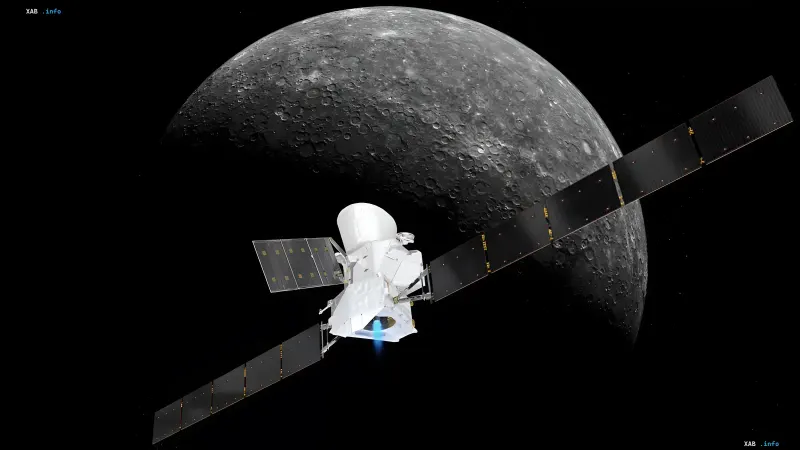
In the early hours of Sunday, November 22, 2026, the European Space Agency (ESA) officially confirmed that the joint European-Japanese BepiColombo probe successfully entered Mercury's orbit. «We have received a signal from Bepi; the spacecraft is now in contact with Earth, and teams at ESOC are busy analyzing telemetry, but the flight dynamics service has already confirmed that the spacecraft has entered Mercury's orbit», ESA stated in a post on social media platform X. Flight control specialists in Darmstadt, Germany, spent several hours verifying data received after the final maneuver before announcing success. The agency promised to provide a new update on the mission's status early next week.
Eight Years and Nearly 10 Billion Kilometers
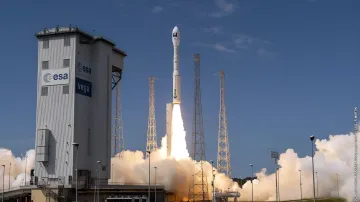
BepiColombo launched on November 20, 2018, from the Kourou spaceport in French Guiana. Over eight years of interplanetary travel, the spacecraft covered a distance of about 10 billion kilometers (roughly 6 billion miles), performing a series of gravity assists at Venus, Earth, and Mercury itself. During the final phase of the journey, the four engines of the European Mercury Planetary Orbiter (MPO) fired for braking: the combined spacecraft slowed down enough for Mercury's gravity to capture it into orbit. According to industry sources, the initial polar orbit measures approximately 590 by 11,640 km.
Two Probes, One Goal
The BepiColombo mission combines two scientific spacecraft: the European MPO and the Japanese Mercury Magnetospheric Orbiter (Mio), developed by JAXA. Throughout the final cruise phase, both probes remained connected, with Mio tucked beneath MPO's sunshield to protect its sensitive equipment from extreme thermal radiation. According to the mission plan, the separation of the two orbiters is scheduled for December 9–10, 2026. Following this, Mio will transition to its own orbit, while MPO will perform a series of additional maneuvers to stabilize its trajectory. The mission's scientific phase, which includes systematic observations of Mercury's surface, magnetic field, and atmosphere, is slated for April 2027.
Why Mercury Is the Inner Solar System's Most Challenging Target
ESA emphasizes that BepiColombo will be the second and most complex mission in history to enter Mercury's orbit. The planet closest to the Sun has proven more difficult for orbiters than even Saturn: proximity to the star creates colossal thermal loads, and the gravitational architecture of the Earth-Sun-Mercury system requires multiple, energy-intensive maneuvers for capture. The smallest planet in the Solar System experiences extreme temperature fluctuations—from +430 °C on the dayside to −180 °C on the nightside—making the engineering of the orbiter's thermal protection and electronics one of the mission's key challenges.
From Mariner 10 to BepiColombo: 53 Years Between First Visit and Orbital Study
The first spacecraft to visit Mercury was NASA's Mariner 10, launched in 1973. It performed three flybys of the planet but did not enter orbit. The next attempt to study Mercury from orbit was NASA's MESSENGER (2011–2015), but BepiColombo is fundamentally different in scale: it is the first mission to simultaneously study the planet's surface, internal structure, magnetosphere, and exosphere from two independent orbits. Scientists expect that BepiColombo's data will answer fundamental questions about the evolution of the inner Solar System, the nature of Mercury's magnetic field, and the formation mechanisms of its anomalously large iron core.
What's Next
In the coming weeks, ESA and JAXA teams will gradually lower the orbit's altitude, adjust its inclination, and prepare the spacecraft for separation. After December 9–10, each probe will begin autonomous operations: Mio will focus on magnetospheric measurements, while MPO will concentrate on surface mapping and spectrometric analysis. The full scientific campaign will kick off in April 2027 and is planned to last for at least one Mercurian year (about 176 Earth days). ESA and JAXA promise to publish initial scientific results as data comes in, with the next official mission status update expected early next week.