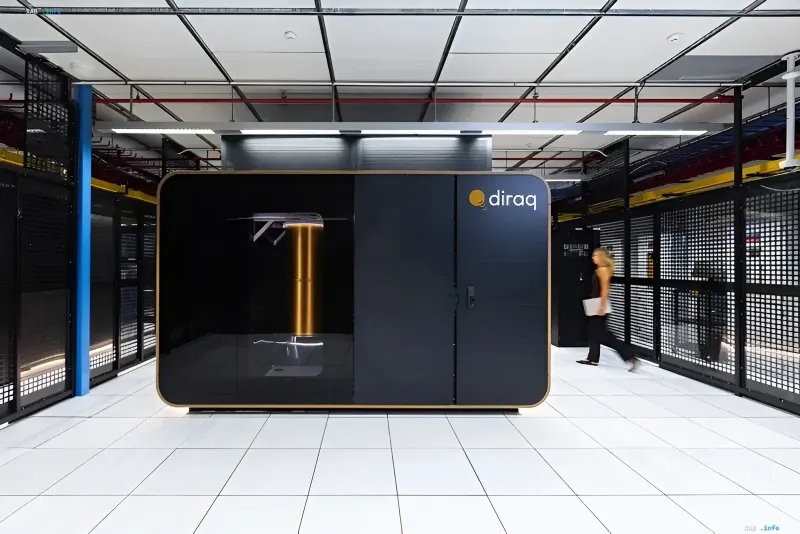
Australian company Diraq has announced the commissioning of an eight-qubit quantum computer based on silicon spin qubits, housed within an active commercial data center operated by Equinix in Sydney. The installation is already operational and located directly next to conventional computing servers, making it the world's first example of integrating quantum hardware into existing server infrastructure without building a separate specialized facility. By comparison, superconducting quantum platforms require bulky, complex, and expensive cryostat systems that cannot be accommodated in a standard server rack. Diraq is testing a fundamentally different approach in practice — a quantum processor that "lives" in the same room as classical servers.
Silicon, Spin, and Classical Manufacturing
The key technological distinction of the Diraq platform is that qubits are implemented via the spin states of electrons in silicon. Traditional semiconductor transistors encode information using electrical charge, whereas Diraq's system performs operations with electron spin. Crucially, the company's quantum processors are produced using conventional CMOS technologies employed in standard microchip manufacturing. This means there are no specific production constraints: neither scaling nor mass production requires constructing new cleanrooms or mastering exotic process nodes. Scaling challenges certainly exist, but they are primarily related to architecture and qubit control rather than manufacturing physics. Consequently, upgrading Diraq's quantum computer, much like classical systems, comes down to replacing the central processor rather than rebuilding the entire infrastructure.
Power Consumption and Dimensions: Numbers That Change the Game
The installation deployed at the Equinix data center consumes less than 20 kilowatts and occupies approximately 15.8 square meters — parameters comparable to a standard server rack. According to Diraq, the company's future quantum computer with practical computational value will consume around 300 kW, which is roughly one-third of the power consumption of competing quantum platforms. The cryogenic cooling system and control electronics are integrated directly into the assembly, eliminating the need for separate cooling infrastructure. The system is designed to operate in close proximity to conventional servers, and interaction with classical processors and GPUs paves the way for hybrid computing, where quantum and traditional nodes execute different parts of a joint task.
The Path to 256 Qubits and Hybrid Computing
The company plans to upgrade the system installed in Sydney to 256 qubits without replacing the entire infrastructure, with work scheduled for 2027. This scaling approach — where simply "replacing the processor" suffices — fundamentally sets Diraq apart from competitors whose platforms require rebuilding the cryostatic and control architecture with each significant increase in qubit count. The hybrid computing model, in which the quantum node handles subtasks inaccessible to classical processors while GPUs and CPUs shoulder the remaining load, is viewed by Diraq as the primary practical application scenario in the near term.
"Quantum at Work": Quantum Computing in Drug Discovery
Alongside commissioning the setup, the company released the report "Quantum at Work," which evaluates the potential application of future quantum computers in drug discovery. According to Diraq's computational model, increasing clinical trial success rates by just 10% using quantum systems could reduce the development cost of a single drug by approximately $600 million. On a US scale, this would theoretically allow up to 25 additional drugs to reach the market annually. At the same time, the editorial team emphasizes: at this stage, the focus is primarily on hardware integration into commercial infrastructure and compatibility verification, rather than demonstrating practical quantum supremacy. Figures from the "Quantum at Work" report remain modeled estimates and are not experimentally verified.
Context and Industry Significance
Placing a quantum computer in an active commercial data center is a milestone that extends beyond a single technological breakthrough. It demonstrates that quantum computing can become not an isolated scientific tool, but a component of standard IT infrastructure. For data center operators, this opens up the opportunity to offer clients hybrid computing services without capital expenditure on specialized facilities. For researchers, it provides access to a quantum resource within the same network where their classical servers already run. Thus, Diraq is laying the infrastructural foundation upon which commercial quantum services can eventually be built, accessible not only to academic laboratories but also to industrial customers.