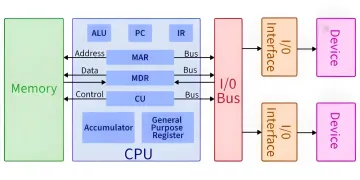
Superconducting components for quantum circuits have historically required dedicated technological platforms and non-standard production lines, sharply increasing the cost and complexity of their integration with silicon electronics. A team of scientists from Quantum Motion, alongside several research organizations, has demonstrated a different approach: a superinductor—an element with high inductance operating in a superconducting regime—was successfully fabricated within an existing 22nm CMOS process by GlobalFoundries. A separate production platform was not developed for this, fundamentally changing the economics of creating hybrid quantum microcircuits.
Titanium Nitride as a Ready-Made Superconducting Inductor
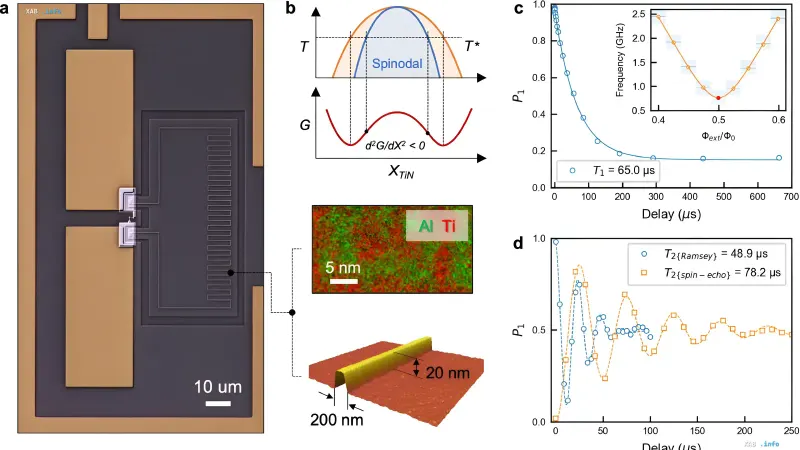
Titanium nitride (TiN) served as the key material. Thin films of this compound are already present in the commercial process node, used within resistor structures, meaning the material is "introduced" into the chip without modifying the recipe. Under deep cooling, TiN transitions into a superconducting state and acquires high kinetic inductance—a property that enables extremely compact inductive elements. Using these films, the researchers fabricated a superinductor with an area of just 18 µm². The inductance density of the resulting element proved to be approximately 10,000 times higher than that of conventional spiral coils used in CMOS microcircuits.
Ready-Made Sensor Node on a Single Die
Crucially, this is not an isolated superconducting element, but a functional node. A resonator with the superinductor and a silicon quantum dot were placed on the same die. Together, they form a radio-frequency single-electron transistor (rfSET)—a sensitive electrical charge sensor used in semiconductor quantum computers to read out qubit states. Thus, the superconducting part and the semiconductor quantum system were integrated into a single silicon microcircuit.
Picosecond-Level Sensitivity
In tests, the sensor recorded very weak electrical signals arising from changes in the quantum dot's charge. Over a 4-nanosecond measurement window, the signal-to-background noise ratio reached 4,500—the signal was 4,500 times stronger than the interference. The authors also calculated that to obtain a signal barely distinguishable above the noise floor (a signal-to-noise ratio of 1), the device theoretically requires just 1 picosecond—one-trillionth of a second. This sensitivity is provided by the special electrical properties of superconducting titanium nitride: its inductance varies depending on signal strength, and the resonator converts these changes into a measurable radio-frequency response. The work's illustrations also present the system's coherence characteristics—an energy relaxation time T1 of about 65 µs, and Ramsey and spin-echo coherence times of approximately 48.9 and 78.2 µs, respectively.
What's Next: Spin Qubits and Mass Production
The next planned stage is the integration of the resonator with multi-gate transistors and the demonstration of fast, high-precision readout of spin qubit states. The use of materials already supported by the commercial CMOS process paves the way for creating more complex superconducting circuits in standard silicon foundries—without the need to build a separate technological base for every class of quantum components.