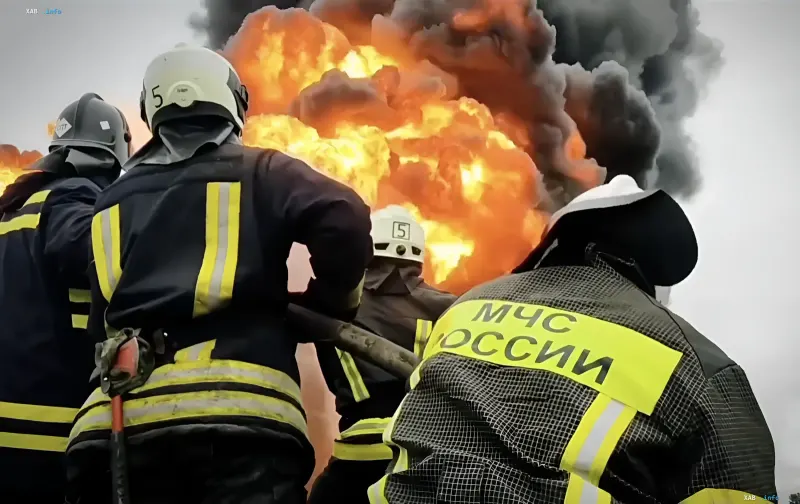
On the night of 4 September 2026, Ukrainian drones struck a fuel infrastructure facility in Adler — the "Rosneft-Kubannefteprodukt" fuel depot. According to RBC-Ukraine, citing a publication by "Radio Svoboda," the attack and the ensuing fire damaged fuel storage tanks, while the protective structures that had been used to shield them failed to work.
Satellite imagery: scale of the damage
A published satellite image, according to the outlet, confirms that during the attack and the subsequent fire, five to six of the ten fuel storage tanks located on the facility's grounds were completely destroyed. This indicates significant local damage to the storage complex and shows that the fire engulfed a substantial portion of the tanks.
Anti-drone nets proved ineffective
As noted in the materials, at the time of the strike, measures were being taken to protect the tanks from aerial attacks: all tanks were covered with special anti-drone nets. However, judging by the aftermath, these structures proved ineffective and failed to prevent the tanks from being hit and catching fire.
Context: a series of strikes on the fuel sector
The attack in Adler was part of a broader series of strikes on Russian oil and chemical industry facilities that same night. Fires were recorded in Sochi and in Bashkortostan, one of which occurred more than 1,000 kilometers from the Ukrainian border. Earlier, the Security Service of Ukraine confirmed the shutdown of two major oil refining enterprises — the "LUKOIL-Nizhnevartovsknefteorgsintez" refinery in Kstovo and the "NOVATEK-Ust-Luga" complex. According to RBC-Ukraine, by the end of August, gasoline production in Russia had fallen to roughly 70% of domestic consumption levels amid the series of strikes on refineries.
Contradictory data
The sources contain inconsistencies in the classification of the facility and in the chain of attribution. On the one hand, the text refers to the "Rosneft-Kubannefteprodukt" fuel depot — a fuel storage facility — while the photo captions call it an oil refinery (NPF), which are technically different types of facilities. On the other hand, the source states that RBC-Ukraine cites the "Russian service" "Radio Svoboda," which does not match the actual status of that outlet. Both versions are presented openly; the final classification of the facility and the precise attribution of the data require additional verification.