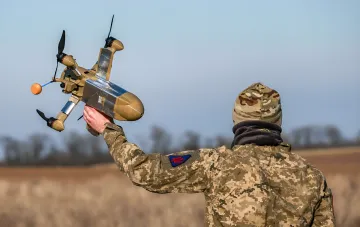
In the RBC-Ukraine podcast "TSE BAZA", Ivan Kyrychevskyi, a serviceman of the 413th Unmanned Systems Forces Regiment "Raid" and Defense Express weapons expert, stated that the initiative in the drone war still belongs to Ukraine, and Russia followed its lead in using jet-powered kamikaze drones, not the other way around. According to him, Ukraine was the first to use jet kamikaze UAVs back in the winter of 2022, while the Russians' possible jet-powered Shahed only became known at the end of December 2023. Thus, the expert argues, Moscow actually repeated an approach already tested by the Ukrainian side rather than creating a new one.
The Ukrainian Arsenal of Mid-Straykes
Kyrychevskyi listed a lineup of Ukrainian jet and medium-range drones that, in his estimation, provide strike depth. This includes the conversion of the Tu-141 Strizh: according to him, its takeoff weight is several tons, the fuselage length is 11 meters, and according to open sources, it could carry a 150-kilogram bomb; even such a device, the expert believes, proved effective enough for strikes against the strategic aviation of the Russian Federation. He also mentioned Palyanytsia, which, judging by publicly available images, he described as something like a simplified Neptune with a takeoff weight of 300 kilograms. Among mid-straykes, the military man named the FP-2 for striking troops in the frontline zone, Bulava and B2 for destroying valuable moving targets, and the Bliskavka drone, created based on the Russian Molniya for cheaper strikes on low-value targets such as UAZ vehicles.
Where the Initiative Lies in the Sky
According to Kyrychevskyi, we could only speak of Russia seizing the initiative if Ukraine, under the pressure of Russian jet drones, began abandoning long-range operations. Currently, in his opinion, the initiative in the drone war belongs to Ukraine: the Russians themselves realize they cannot neutralize the threat from Ukrainian mid-straykes with mobile fire groups or their own interceptors at the desired level, and Ukraine outperforms them in the quantity race.
Constraints on Russian Scaling
Assessing Russia's potential, the expert emphasized that the launch capability cannot be overlooked: fuselages must be equipped at launch points, and trained operators must guide the drone to the target. He suggested that the Russians might have nuances with properly trained operators, citing as an example recent drone strikes on bridges, which, according to him, involved the elite 50th Varyag Brigade. Kyrychevskyi also noted that even if Russia is gradually replacing Chinese engines in jet Shaheds with its own, this does not mean a rapid jump from three thousand to thirty thousand products per month: scaling takes time and is not cheap—the Russians themselves, he says, admit that Geran-4 and Geran-5 cost from $200,000.
Ukrainian Adaptation and Strikes on Launch Points
Regarding Ukrainian adaptation, Kyrychevskyi said that the segment of interceptor drones was being increased, including within his regiment, and in September there were several successful strikes on jet Shahed launch points in the Donetsk area. In his opinion, even if both Ukraine and Russia reach tens of thousands of jet UAV launches monthly next year, it will not mean Russian superiority.
Jet Drones in the West and Private Air Defense
Jet drones are reaching the western regions of Ukraine: on October 16, they attacked the Lviv region, where air defense shot down three enemy drones, and a man was injured due to falling debris in Dublyany. According to reports, during certain attacks, up to 85% of jet drones are successfully shot down. Simultaneously, Nova Poshta has launched private air defense and is already shooting down Shaheds.