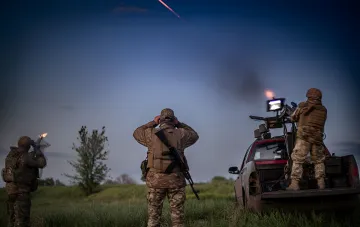
On the night of October 4, Russian forces launched a massive air attack on the territory of Ukraine, deploying strike drones of various types and devices codenamed "Banderol." The raid was carried out simultaneously from six strategic directions, including Russian regions and temporarily occupied territories. The Air Force of the Armed Forces of Ukraine recorded the launch of 135 air attack weapons, dominated by Shahed-type drones, including their jet modifications, as well as Gerbera, Dan-T, and decoy devices.
Scale of the Raid and Ukrainian Air Defense Operations
The intensity of the nighttime threat required the maximum mobilization of air defense forces and assets across the country. As of 08:30 in the morning, air defense and electronic warfare units successfully shot down or suppressed 123 enemy drones of various modifications, including two "Banderol" / "Dan-T" units. Nevertheless, it was impossible to completely avoid consequences: enemy impacts were recorded at 5 locations, while the fall of debris from intercepted targets caused local destruction at another 5 locations.
Contradictory Data
It is worth noting that discrepancies traditionally arise in the information space regarding the scale and results of nighttime incidents reported by opposing sides. Ukrainian specialized departments report the massive use of more than a hundred drones focused on Ukraine's rear infrastructure. At the same time, Russian sources, in particular monitoring resources and reports from the Ministry of Defense of the Russian Federation, claim to have repelled mirror attacks on their own regions, citing alternative interception figures amounting to hundreds of unmanned aerial vehicles. Such information gaps reflect a high degree of tension in the airspace and the deployment of massive arsenals by both sides.
Strategic Context and Infrastructure Threat
Of particular concern to experts is the persistence of the enemy's tactics aimed at exhausting Ukraine's energy system and logistics ahead of the winter period. As noted in recent analytical publications by foreign outlets such as the Washington Post, Russian forces have recently concentrated strikes on critical infrastructure, including bridges across the Dnipro River in Kyiv. Constant attacks on the capital's transport arteries could cause severe damage to load-bearing structures, creating a threat of a large-scale logistical crisis and forcing authorities to take stringent security measures.