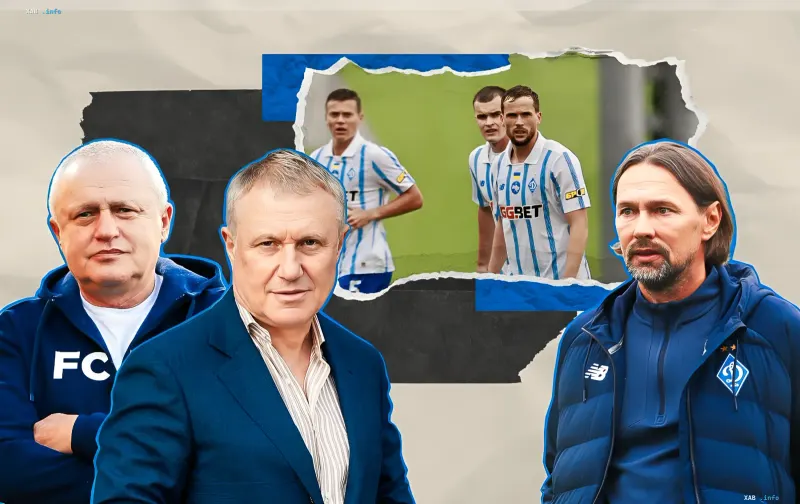
Dynamo Kyiv is going through another turbulent season: the team has crashed out of the Europa League and Conference League qualifiers, sits outside the top 3 in the UPL, and recently exited the Ukrainian Cup after a crushing defeat against Shakhtar Donetsk. A natural question arises: what is wrong with today's Dynamo, and when did the reverse movement in the club's development begin? There is a true popular proverb: if Dynamo loses any match, it is better not to enter social media — anger pours from all corners with powerful force, providing an assortment of arguments as to why everything is lost for the club and it will never be the same again. But if we put emotions aside, everything is very simple: the world has changed, but Dynamo has not.
The Strategy of "Patching Holes"
An authoritative view of the situation begins with doubts about the very position of "Director of Strategic Development": it seems that strategy is precisely what Dynamo lacks today. Recent personnel decisions on the coaching bridge can be called the concept of "patching holes." Let's recall: Lucescu left, Shovkovskyi became acting coach. The positive impulse that the legendary goalkeeper brought to the team worked — Dynamo saved that season, and a year later won the championship without a single defeat. However, Shovkovskyi did not receive the necessary reinforcements for European competitions: after passing Maltese Hamrun Spartans in the second round of the UCL qualifiers, Kyivans were eliminated by Cypriot Pafos. They managed to make it to the Europa League, but their performance in the main stage was unsuccessful — 34th place out of 36. In the championship, the team also crumbled, issuing a series of four consecutive defeats. Shovkovskyi's dismissal under such conditions looked logical.
Repetition of the Scenario and Credit of Trust
The team was picked up by Ihor Kostiuk, who worked with the youth team, and the scenario repeated: the situation stabilized, and the acting coach turned into a full-fledged head coach. However, already at the end of last season, the Surkis brothers had every reason to thank Kostiuk for his work and start looking for a new specialist: yes, Dynamo won the Ukrainian Cup, but 4th place in the championship can hardly be regarded as anything other than a catastrophe. Despite this, Kostiuk remained in office, and in the new season, qualifications failed first in the Europa League and then in the Conference League. Special irritation was caused by the fact that in two matches against Qarabağ, one of Dynamo's most experienced players, Vitaliy Buyalskyi, was given only nine minutes by the coaching staff across the two matches. Next came a defeat by Bukovyna (0:3) — and the bosses' hand with a Parker pen did not make a sharp move under the dismissal order. The question arose: where does such a credit of trust come from for a coach who failed the previous championship, European qualification, and was soundly beaten by a team that had just been promoted from the First League? Kostiuk's dismissal became a matter of time — the clock struck after the loss to Polissya (1:3), although Dynamo played with a man advantage from the 6th minute. The coach himself stated after the match that the opponent's red card played a cruel joke on Dynamo.
From Lucescu and Rebrov to the Illusion of Continuity
The strategy of "patching holes" may continue with Maciej Kędziorek: if he does not convince club management of his suitability for the position, there is a chance to break this circle of duct tape and finally engage in full-scale repairs. The last time Dynamo's strategy was effective was in 2020, when Mircea Lucescu took charge of the team. Over three years, the Romanian specialist squeezed the maximum out of his players, opening Illia Zabarnyi to the football world, whose sale to Bournemouth (and from there to PSG) brought serious money to the club. Add to this Mykolenko's transfer to Everton, the progress of Vanat and Tsyhankov. During Lucescu's time, Dynamo played in the Champions League against Barcelona and Bayern — and this also brought significant funds.
The Illusion of a Successful Player-Coach
It was Serhiy Rebrov's successful work from 2014 to 2017 that made many believe that a successful former Dynamo player could become an equally successful head coach. Rebrov is still the last coach who managed to take Dynamo to the Champions League playoffs (2016) and the Europa League quarterfinals (2015). In fact, however, this hypothesis is nothing more than an illusion: in this story, one should not forget that Rebrov had a qualified coaching staff working with him, the most prominent figure of whom was Raul Riancho. In his final season, Rebrov coached Dynamo without his assistant, and the quality of play changed slightly for the worse. Although it must be admitted that Serhiy Stanislavovych did a tremendous job.