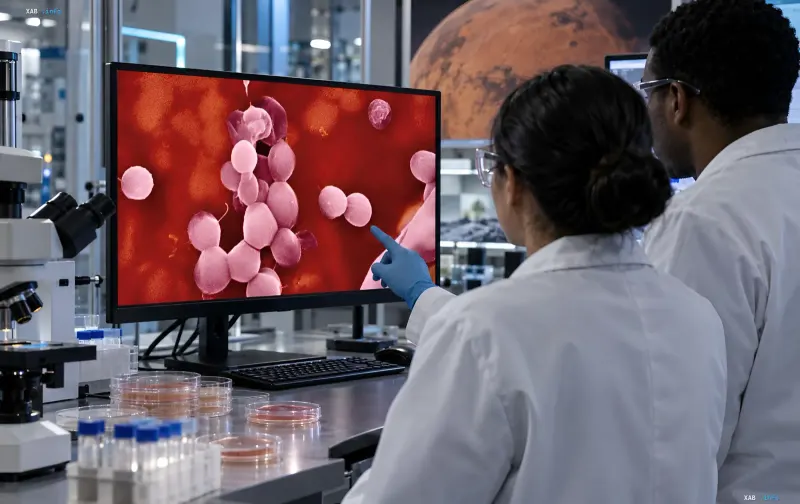
A team of University of Florida researchers led by Dr. Adam Robinson, along with colleagues from the Natural History Museum of Los Angeles County, has published the results of a 180-day experiment that could significantly alter our understanding of Mars's ability to support life. In sealed chambers replicating the combined extreme factors of the Red Planet, halophilic bacteria Haloferax volcanii not only survived but began to actively multiply, albeit much slower than under natural conditions. The work was posted on the bioRxiv preprint server and has already received coverage in international scientific publications, including New Scientist.
The Experiment: All Hazardous Factors Simultaneously
The key difference between this study and previous laboratory work lies in the methodology: the scientists applied all Martian extreme factors simultaneously rather than individually. In nature, Haloferax volcanii inhabit extremely saline bodies of water—the Dead Sea, the Great Salt Lake in the USA, and similar hypersaline environments. In the experiment, microorganism cultures were placed in sealed chambers replicating the combination of conditions typical of the Martian environment: high salt concentration, specific chemical composition, and a lack of oxygen in the format familiar to terrestrial aerobes. It was the simultaneous impact of all factors that provided a more realistic picture of what might happen to microbes in the subsurface layers of the Red Planet.
How Bacteria Adapted: Biofilms and Alternative "Breathing"
During the six-month observation, it became clear that the microorganisms not only remained viable but continued to divide. To obtain energy, the bacteria switched to using Martian chemicals instead of oxygen—meaning they mastered anaerobic metabolic pathways typical of extremophiles. To protect themselves against dehydration in conditions where liquid water quickly evaporates, the colonies united into biofilms—dense clusters of cells covered in a protective mucous layer. Over 180 days in the extreme chamber, the colonies practically did not lose internal water, indicating the high efficiency of this survival strategy.
Limitations: 21 Degrees Versus Minus 60
The study's authors emphasize that the results obtained are not direct proof of life on Mars. Laboratory tests were conducted at 21 degrees Celsius, whereas the average temperature on the surface of the Red Planet is about minus 60 degrees. Furthermore, the experiment modeled conditions hypothesized to exist in shallow subsurface brine reservoirs—ones that have not yet been discovered but whose presence cannot be ruled out. The scientists also note that if potential Martian microorganisms evolved on the planet over billions of years, their resistance to extreme conditions should be significantly higher than that of the terrestrial analogs used in the experiment.
Context: From Viking to Subsurface Layers
Interest in the possibility of life on Mars is not new. Back in 1976, the American spacecraft Viking 1 conducted the first direct experiment to search for extraterrestrial life: the Labeled Release instrument added liquid nutrients with a radioactive label to Martian regolith and recorded gas emission. Initially, the result was considered confirmation of biological activity, but subsequent analysis showed the reaction was purely chemical. For many years, the scientific community concluded that the Martian surface was uninhabitable due to dryness, intense ultraviolet radiation, and low atmospheric pressure. However, recent studies have shifted the focus from the surface to subsurface layers, where conditions suitable for active metabolism could theoretically have been preserved.
What's Next: New Tests in Extreme Cold
Currently, the University of Florida team is preparing a new series of experiments at even lower temperatures and pressures to bring laboratory conditions closer to real Martian ones. If the bacteria retain the ability to multiply under these conditions as well, the argument that the subsurface layer of the Red Planet can support active metabolism will become significantly more convincing. For Mars exploration missions, this means that the priority in searching for signs of life should not be exposed surface areas, but zones where a liquid environment may be preserved under an ice crust or within salt deposits.