An international team of researchers has presented scientific findings indicating that Earth's metallic core is not an isolated reservoir, but over billions of years has been gradually transferring primary elements and hydrogen into the lower layers of the mantle. This discovery was published in the peer-reviewed journal Science Advances and alters established concepts regarding the geochemical evolution of our planet.
Evolution of Planetary Interiors and Layer Formation
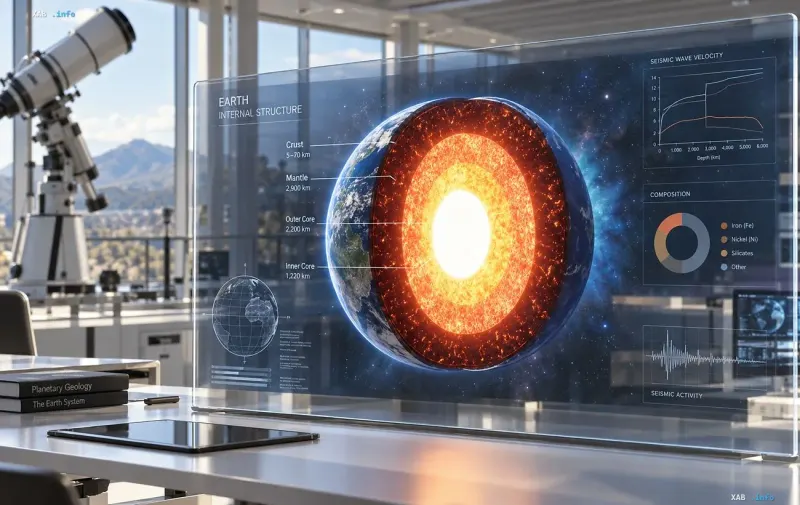
About 4.5 billion years ago, the young Earth was in a molten state. Through gravitational differentiation, heavy molten metals, primarily iron, plunged toward the center of the planet, forming a dense metallic core. Meanwhile, lighter silicate compounds rose upward, forming the mantle and the future Earth's crust.
For a long time, geophysicists and geochemists proceeded from the hypothesis that these two giant layers were virtually isolated from each other after the early differentiation phase completed. However, modern computer modeling techniques simulating conditions in the extreme deep interior have forced scientists to reconsider this fundamental postulate.
Isotopic Analysis and the Mystery of Volcanic Rocks
During the new study, specialists examined in detail the distribution of two forms of hydrogen—standard light hydrogen and heavy deuterium—under conditions modeling the cooling of the ancient magma ocean. It turned out that although the overall isotope distribution pattern in the mantle appears relatively uniform, this mechanism is insufficient to explain the anomalously low levels of deuterium.
Anomalously low concentrations were recorded in basaltic lava samples brought up from the Earth's depths in Baffin Island within the Canadian Arctic, as well as in modern Iceland. To explain these unique chemical signatures, researchers proposed a model suggesting that light hydrogen has been continuously migrating from the metallic core into surrounding mantle rocks for billions of years.
Implications for Geochemistry and Future Plans
According to the scientists, during the core's formation, the sinking iron actively absorbed light hydrogen, leaving the metallic center depleted in deuterium. The gradual leakage of this primordial volatile material directly affects the composition of deep magmatic flows and lavas reaching the Earth's surface.
Significance of the Discovery for Earth Sciences
The obtained data clearly confirm for the first time the existence of deep mass exchange between the Earth's core and mantle. Moving forward, the research team intends to closely examine the physical and chemical mechanisms driving this transport of matter across the boundary separating Earth's two largest geospheres.