In early May 2024, a series of powerful solar flares triggered a geomagnetic storm with consequences that caught space weather specialists by surprise. Two stable radiation belts revolving around Earth split into four separate regions of heightened charged particle concentration for roughly two months. According to data published in npj Space Explorations, this marked the first recorded instance of four belts persisting for longer than a month. For satellite operators, such a configuration shift in near-Earth space poses a genuine threat: orbits that previously had low radiation backgrounds suddenly saw zones of increased particle density.
How Van Allen Belts Work
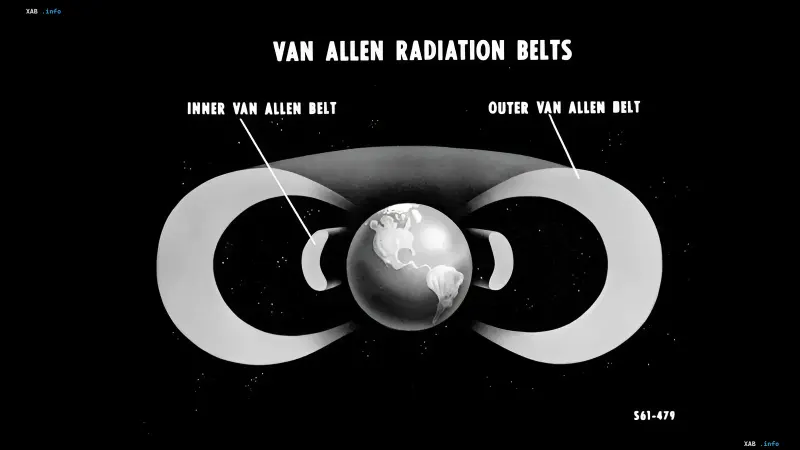
Earth's two radiation belts were discovered in 1958 by America's first satellite, Explorer 1, and named after physicist James Van Allen. The inner belt sits at an altitude of approximately 1,000–12,000 km and consists primarily of high-energy protons, whereas the outer belt, spanning 13,000–60,000 km, is formed mostly by high-energy electrons. Traditionally, a region of depleted electron concentration known as the "slot" exists between them. Even a single such high-energy particle can disable a satellite's onboard electronics or cause irreversible damage to human cells, making prolonged belt configuration changes hazardous for both hardware and space crews.
The "Mother's Day Event" and PROBA-V Observations
Scientists recorded the splitting of the belts into three and then four regions thanks to observations by the European PROBA-V satellite, operating in a Sun-synchronous polar orbit at an altitude of 820 km. The changes emerged following a powerful geomagnetic storm on May 10–11, 2024, dubbed the Mother's Day Event. The disturbance storm time (Dst) index during the storm reached −412 nT, making it the strongest geomagnetic storm in two decades; auroras were observed as far south as Russia's Stavropol Krai during those days. Data was gathered by the Energetic Particle Telescope (EPT), capable of recording electrons with energies from 0.5 to 8 MeV across six energy channels, as well as protons with energies from 9.5 to 248 MeV.
The Splitting Mechanism: Electron Displacement
Analysis of EPT readings showed that during the May storm, the flux of charged particles surged, and the "slot" between the inner and outer belts partially filled with electrons. Scientists described this process as electron displacement: under the combined influence of factors including solar wind and plasma, as well as anthropogenic activity (radars, communication systems) as noted by the authors, high-energy electrons began to redistribute and concentrate in other regions of near-Earth space. The aggregate electromagnetic environment formed three and then four temporarily stable regions of high magnetic field line concentration where the displaced electrons gathered—meaning Earth temporarily gained two extra radiation belts.
Return to Normal and Lessons for Astronautics
By August 2024, the configuration returned to the familiar two-belt state. Later, during a period of heightened solar activity in late autumn, a third belt temporarily re-appeared. Three radiation belts around Earth had been observed previously, but four belts lasting longer than a month have been recorded for the first time. The authors emphasize that such phenomena must be studied and predicted: human presence in space is growing, and unexpected radiation backgrounds on previously "clean" orbits can lead to equipment loss and harm crew health. PROBA-V's observations serve as an argument for developing space weather monitoring systems and revising radiation safety calculations for orbital spacecraft.