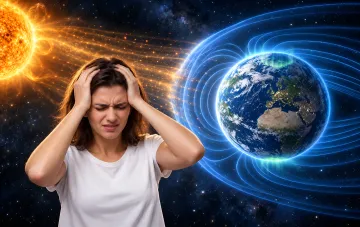
On Wednesday, September 16, 2026, Earth is under the influence of elevated geomagnetic activity. According to the latest forecasts from the American NOAA Space Weather Prediction Center, isolated periods of G1 level — the lowest category of geomagnetic storms on the five-step scale — are possible during the day. Activity may also remain elevated in the coming days, so experts recommend monitoring the indicators in real time.
What the NOAA Space Weather Center Says
According to NOAA, unstable and active geomagnetic conditions are expected on September 16, with the G1 level possibly reached during certain periods. The cause is cited as the simultaneous influence of two factors: fast solar wind emanating from a coronal hole and a plasma cloud associated with a recent coronal mass ejection. It is precisely the overlap of these flows that creates disturbances in Earth's magnetic field.
The Kp Index: Why This Is Not a "Powerful Storm"
The Kp index is used to assess disturbances in Earth's magnetic field. On the NOAA scale, a Kp value of 5 corresponds to G1 level, Kp 6 — G2, Kp 7 — G3, and the highest level, G5, begins at Kp 9. Therefore, it is incorrect to call the phenomena expected on September 16 a "powerful geomagnetic storm": the matter is primarily one of elevated geomagnetic activity and possible brief periods of a weak storm.
Forecast for September 17 and the Dynamics of the Indicators
According to the forecast for the following day, geomagnetic activity may also remain elevated: experts expect that on September 17 activity may locally reach storm level G1 due to the possible arrival of a coronal mass ejection at Earth. At the same time, space weather forecasts may change after the solar material has actually reached Earth, so the Kp values and storm level are updated in real time.
Contradictory Data
Assessments of the severity of the event differ among sources. Some publications, citing observations by scientists at the Space Research Institute of the Russian Academy of Sciences (IKI RAS), emphasize the star's "alarming behavior" and paint red scenarios, which may give the reader the impression of an impending severe geomagnetic storm. At the same time, forecasts based on NOAA data record only the G1 level — the lowest on the five-step scale — and explicitly state that this is not a "powerful" storm. Thus, the actual level of disturbances (G1) is confirmed, while the degree of "alarm" is interpreted differently.
Impact on Technology and People
G1 is the lowest level on the five-step NOAA scale. Under such conditions, minor fluctuations in power grids and small effects on satellite operations are possible. The probability of aurora occurrence may increase at high latitudes. The forecast for September 16 does not indicate an extremely strong geomagnetic event; however, the coming days remain a period of elevated activity, and NOAA will update its forecasts in the near future.