By 2026, Russia's digital military registration infrastructure has transitioned from pilot to permanent operational mode. The key structural change is the automation of enforcement measures: the system imposes an exit ban immediately after generating an electronic summons, without the stage of personal delivery for signature. According to open reports, the mechanism is already applied on a scale affecting a significant number of citizens, shifting the issue from an individual administrative procedure to a systemic tool for state management of population mobility.
Legal Mechanics and the Starting Point of the Ban
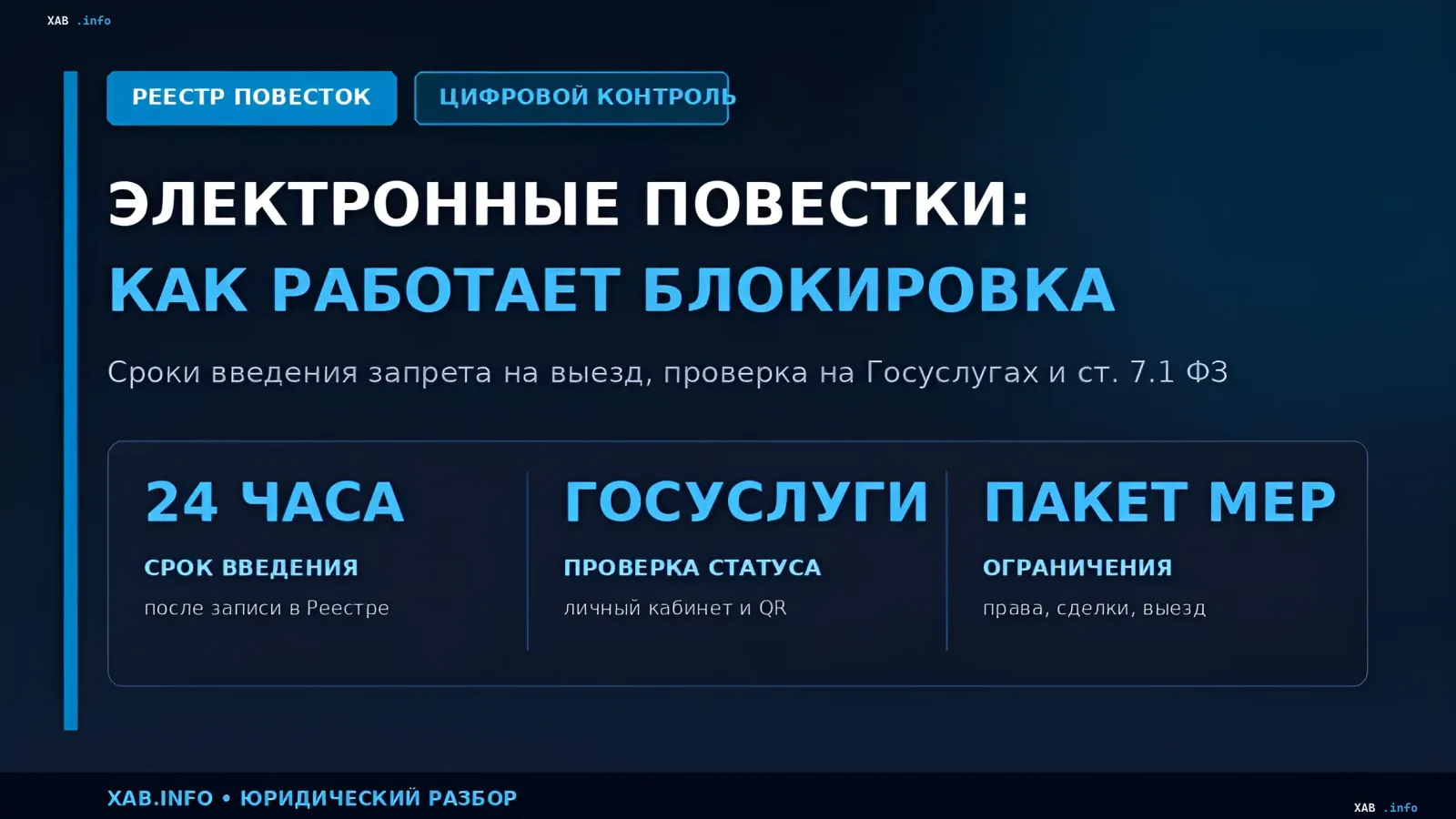
The legal basis is Article 7.1 of the Federal Law "On Military Duty and Military Service" in the version linked to a package of regulatory acts, including Law No. 127-FZ. According to the recorded procedure, a summons is deemed delivered after seven days from the moment of entry into the public Summons Registry; a duplicate notification is sent to the personal cabinet of the "Gosuslugi" portal. The decision to ban exit is formed algorithmically and transmitted to the Border Service of the FSB within 24 hours. It is precisely this automatic loop, rather than the decision of a specific official, that determines the actual date the restriction comes into force.
Package of Enforcement Sanctions for Non-Appearance
In the absence of appearance within 20 calendar days from the appointed date, the system activates an expanded package of restrictions that goes far beyond border control. It includes a ban on registration as an individual entrepreneur and self-employed, suspension of the right to drive vehicles and register cars, blocking of state registration of real estate transactions, as well as refusal to provide bank loans and credits. Formally, these are enforcement measures, however, in combination, they create a comprehensive economic barrier affecting the citizen's entrepreneurial, property, and financial activity.
Macroeconomic and Social Context
From a macroeconomic perspective, the automated package of sanctions represents a tool for the forced immobilization of labor and capital. Blocking the registration of individual entrepreneurs and self-employed persons, as well as real estate transactions, directly affects turnover in the real sector and the secondary housing market, limiting asset liquidity for a significant cohort of the working-age population. Simultaneously, the refusal of credit reduces consumer and investment demand. Thus, a mechanism designed as administrative-military de facto functions as a channel for transmitting restrictions into the banking, property, and entrepreneurial segments of the economy, forming long-term structural consequences for business activity.
Procedure for Checking Status and Lifting Restrictions
To verify the existence of an active ban before traveling, it is recommended to use two channels: the "Military Registration" tab in the personal "Gosuslugi" cabinet to check active notifications from the military commissariat, as well as authorized access via ESIA to the official Summons Registry portal to obtain an extract of issued directives. All enforcement measures, according to the recorded procedure, are automatically lifted within 24 hours after appearing at the military commissariat or upon confirmation of a valid reason for non-appearance through the government services portal. The speed of lifting is critical, as restrictions continue to operate in the border and financial loops until the appearance is recorded.
Contradictory Data
In the regulatory and media landscape, there is a discrepancy in defining the moment from which the ban specifically acts. On the one hand, formulations indicate that the restriction is imposed from the day the summons is placed in the registry; on the other hand, the summons itself is legally deemed delivered only after seven days from this placement. This creates duality: actual blocking at border control may occur earlier than the formal "delivery" deadline, creating legal uncertainty for the citizen in the first seven days. Furthermore, public reports record a mass nature of blockages as early as October 2025, while the described mode is positioned as a stable practice of 2026, requiring clarification of the chronology of the transition from targeted to systemic application of the mechanism.