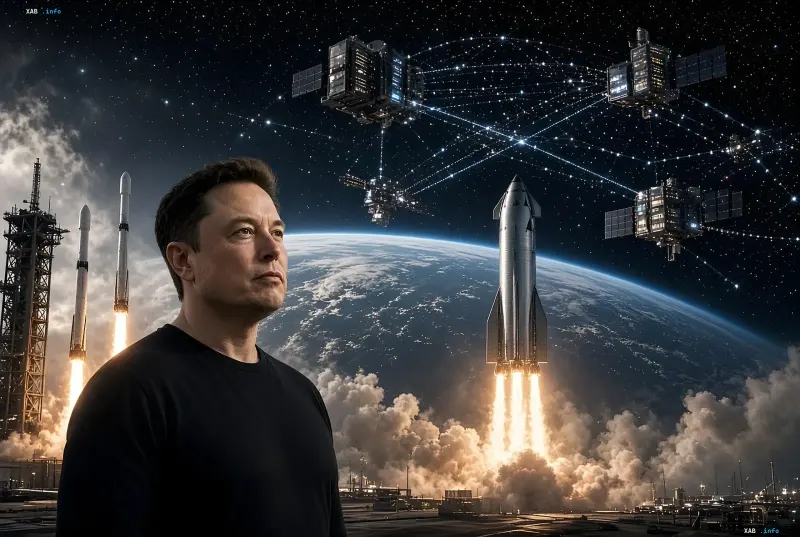
The gap between conservative financial forecasts and actual industry trends in global space exploration continues to widen. According to estimates by Goldman Sachs analysts, the global space industry will reach $1.8 trillion by 2035. However, SpaceX founder Elon Musk has publicly called these figures overly cautious, stating that future figures will be 'far larger.' This is reported by ixbt.com, citing the billionaire's reaction to the bank's report.
Goldman Sachs' Conservative Scenario
The financial institution builds its forecast on several stable growth drivers. Analysts cite the declining cost of placing payloads in orbit, the increase in private investment in the sector, and the expansion of financing opportunities on the open market as key factors. By their calculations, it is precisely these processes that will ensure multiple growth of the industry over the next decade, reaching the $1.8 trillion mark by the mid-2030s.
Elon Musk's and SpaceX's Position
The head of SpaceX reacted to the bank's estimate briefly and concisely, considering it understated. In the view of experts, Musk's confidence is based on the company's technological breakthroughs — primarily mass production and the reuse of rockets — as well as the implementation of fundamentally new business models that are not fully accounted for in classic financial models. Musk effectively indicates that the market's potential goes beyond even the optimistic scenarios of traditional investment banks.
Context: Leadership in Launches and Satellite Networks
The discussion about the scale of the space economy takes place against the backdrop of SpaceX already dominating commercial launches and the deployment of satellite constellations. The company has launched more spacecraft into space than all other industry players combined, which forms a real basis for more aggressive forecasts. It is precisely the operational results, and not theoretical models, that essentially allow Musk to consider Goldman Sachs' estimate a lower bound rather than a target value.
What This Means for the Market
The divergence of opinions between the largest private space operator and one of the world's leading banks reflects a deeper problem: financial institutions have not yet learned to adequately assess the speed of technological transformation in the industry. If Musk's forecast turns out to be closer to reality, it could reshape investment strategies, sector company valuations, and government space programs. In any case, 2035 will be a checkpoint at which it will be possible to test whose model — conservative or radical — proved more accurate.