Cosmological Model Crisis: Data vs. Theory
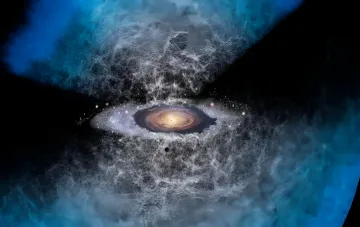
On August 8, 2026, the scientific community is discussing the results of a study capable of overturning fundamental conceptions of the structure of the universe. An authoritative journal, Monthly Notices of the Royal Astronomical Society, has published a work that questions one of the main ideas of modern cosmology — the theory of the accelerated expansion of the Universe. For decades, scientists believed that the cosmos is expanding at an increasing rate, which was explained by the presence of hypothetical "dark energy." However, new data suggests that the Universe may not be expanding uniformly in all directions, and the acceleration itself could be an artifact of measurements.
Traditionally, astronomers use Type Ia supernovae to measure the expansion rate of the cosmos. These objects occur in binary star systems with white dwarfs, which either accrete matter from a companion star until reaching a critical mass or merge with another white dwarf. Thanks to the assumed standard brightness of these explosions, scientists calculate the distance to them, and based on redshift, their recession velocity. It was on the basis of these observations at the end of the 20th century that the theory of accelerated expansion was formulated, for which scientists received the Nobel Prize.
Calculation Error: The Influence of Stellar Age
Researchers analyzed the extensive Pantheon+ catalog of supernovae and applied a new correction for the age of progenitor stars, developed by astronomers from Yonsei University. It turned out that the standard brightness of supernovae depends on the age of the stellar system, which was not previously taken into account with sufficient accuracy. After introducing this correction, the picture of the expansion of the Universe underwent radical changes. Scientists discovered an anomalous pattern: the effect previously explained by accelerated expansion is most pronounced in the direction in which the Milky Way is moving, and gradually weakens with increasing distance.
This discovery suggests that the observed acceleration could be a consequence of local peculiarities of the motion of our Galaxy and inaccuracies in the calibration of supernova brightness. According to the authors of the work, the Universe continues to expand, but it is not accelerating, as was believed in recent decades. On the contrary, the rate of this expansion may be gradually decreasing. If the scientists' conclusions are confirmed, this will cast doubt on one of the main models that astronomers have used for decades to explain the evolution of the Universe.
Solving the "Hubble Tension" and New Horizons
The new work may help resolve the so-called "Hubble tension" — a long-standing problem where different methods of measuring the expansion rate of the Universe yield different results. This problem has existed for many years and has caused controversy in the scientific community. If the new model proves to be correct, it could explain discrepancies in measurements and lead to a revision of cosmological parameters. Furthermore, the new work could help understand the nature of dark energy, which remains one of the main mysteries of modern physics.
According to the authors, the obtained data does not confirm that the Universe expands at the same speed in all directions, an assumption upon which modern cosmological models are built. This discovery opens new horizons for research and may lead to a revision of many fundamental conceptions of the structure of the universe. Scientists continue to analyze data and look for additional confirmation of their conclusions.
Contradictory Data
Despite the sensational nature of the discoveries, there are different points of view in the scientific community regarding the interpretation of the new data. On the one hand, the authors of the study claim that their methodology allows for a more accurate account of the age of stellar systems and thereby corrects measurements of supernova brightness. On the other hand, critics point out that the corrections may not be accurate enough and that the observed effects may have other causes. Some scientists believe that additional observations and independent confirmations are necessary for final conclusions.
Furthermore, there are disagreements regarding how significant these results are for the general cosmological model. Some researchers believe that even if the acceleration of expansion turns out to be an illusion, it does not necessarily mean that dark energy does not exist. Perhaps it manifests itself in other forms or affects the Universe in a different way. Thus, although the new study generates great interest, final conclusions are premature.