
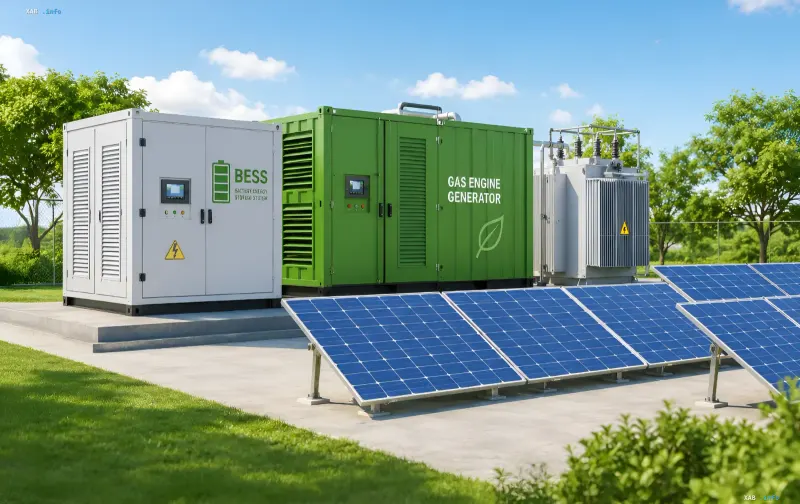
In the context of energy system instability, autonomy has ceased to be merely an option for business—it has become a condition for survival. Constant fuel purchases for generators "wash out" working capital, making traditional methods of electricity supply economically inefficient. Today, own-generation is a strategic investment that protects companies from downtime and guarantees 24/7 operation.
RBC-Ukraine, together with OTP Bank JSC and the company YASNO, publishes a clear algorithm for transitioning to energy independence. Experts explain how to attract preferential loans at the "5-7-9%" rate, calculate real payback periods, and implement ready-made turnkey technical solutions.
Strategy instead of random choice
Successful energy modernization begins not with buying the first available equipment, but with the right strategy. It is important for businesses to first analyze the consumption profile, design the system as a single complex, and immediately provide for the integration of digital management platforms.
OTP Bank JSC finances all main technologies of distributed generation: solar power plants, energy storage systems (BESS), gas turbine and gas piston power plants, cogeneration units, and wind generation. This gives enterprises the opportunity to choose a solution that best suits the specifics of production and its energy needs.
Technical partners of the bank, in particular YASNO, work on the same principle: before selecting equipment, specialists analyze the consumption profile of a specific enterprise and offer solutions tailored to its tasks.
Hidden losses: why downtime costs more than equipment
"The main approach of most companies is to evaluate investments in generation only through a direct comparison of equipment costs and savings on electricity. In fact, today businesses must take into account a significantly wider range of factors. First and foremost—this is the cost of downtime. For many manufacturing plants, logistics centers, or retail outlets, even a few hours of power outage can mean loss of customers and, accordingly, direct financial losses," notes Ruslan Doroshenko, Head of Projects and Sales Programs for Energy Products at OTP Bank JSC.
The modern approach to evaluating payback from OTP Bank includes:
- Savings on purchasing electricity from the grid.
- Avoiding losses through production downtime.
- Predictability of costs for years to come.
- Potential income from selling excess electricity to the grid.
OTP Bank has an extended network of technical partners who calculate the project mathematics at the planning stage of the deal. After the payback period is over, the company receives a free resource, and the investment turns into a source of constant savings and long-term competitive advantage.
Financial instruments and project financing
OTP Bank has created comfortable conditions for entering energy projects thanks to a combination of state and international financial instruments. The bank evaluates projects comprehensively, where a positive decision depends on the financial health of the business.
For solar stations, generation calculations are critical; for cogeneration, stable fuel supply and heat production economics are key. The bank is actively moving towards wider use of project financing, where the key collateral is the future cash flow of the energy object itself.
Digital management: the key to efficiency
Installing a solar power plant or an energy storage system in itself does not guarantee maximum efficiency. Businesses achieve the best results when all energy assets work as a single system and automatically respond to changes in consumption, generation, and market conditions.
Today, the key element of energy independence is the integration of three components:
- Own generation.
- Energy storage systems (BESS).
- Digital energy resource management system (EMS).
Generation covers part or all of current demand, batteries provide backup power and help smooth peak loads, while the EMS acts as a single control center that analyzes data in real-time and coordinates the work of all elements.
For such tasks, YASNO has developed its own energy management system, YASNO Power EMS. It allows enterprises not only to control consumption and generation but also to automatically choose the most profitable scenario for using energy resources depending on production needs and market conditions.
Thanks to the implementation of EMS, business gets not only additional control over energy consumption but also increases the resilience of operational activities. The system automatically replaces expensive grid electricity with own generation or stored energy, helps avoid unnecessary costs during peak load hours, and reduces the payback period for investments in energy infrastructure. As a result, the enterprise gets a higher level of energy independence, cost predictability, and continuity of operation.