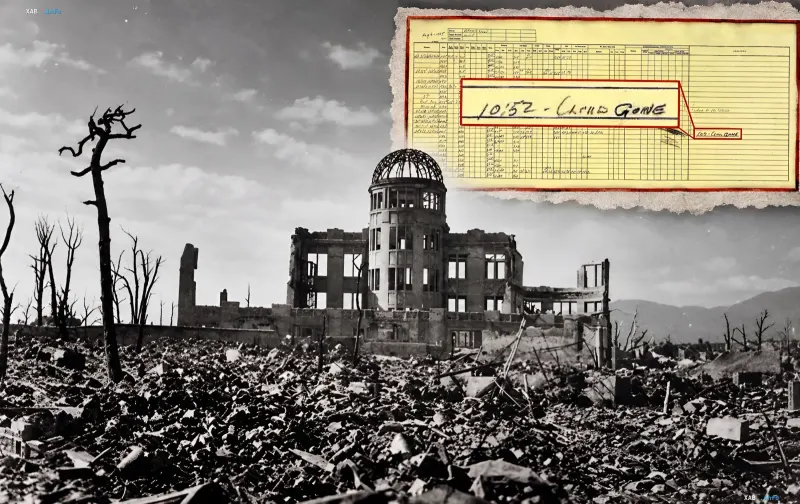
More than 80 years after the atomic bombing of Hiroshima, scientists have obtained new data on the scale of the nuclear firestorm — and the source was neither satellite imagery nor seismic sensors, but a brief handwritten note in the flight log of the B-29 bomber Enola Gay. The study, published in the journal Geophysical Research Letters, shows that the smoke cloud from the Little Boy bomb rose to at least 11.3 kilometers, which fully aligns with theoretical models of nuclear winter and provides science with a rare real-world benchmark for calculating the climatic consequences of massive nuclear conflicts.
'CLOUD GONE': The Entry That Proved Key to Modeling
In 1945, 97 minutes after the atomic charge was dropped on Hiroshima, navigator Theodore Van Kirk made a concise entry in the Enola Gay flight log in capital letters: 'CLOUD GONE'. At first glance, this is an ordinary operational note: the crew recorded that the characteristic mushroom pillar rising above the city was no longer visible from the cockpit of the aircraft, which was between 750 and 764 kilometers away. However, as a team of researchers led by atmospheric physicist David Romps from the University of California, Berkeley, established, the cloud did not physically dissipate or drop below the horizon. The crew simply stopped distinguishing it due to atmospheric haze that obscured long-range visibility. It is this distinction — between actual disappearance and optical invisibility — that allowed scientists to set the task of determining the minimum height of the plume.
100,000 Computer Simulations for a Single Question
To translate the observation that 'the cloud is not visible' into a quantitative height parameter, the researchers reconstructed the weather conditions of August 1945 in the Hiroshima area and ran about 100,000 computer simulations of the smoke plume's spread. The calculations included an optical model that accounts for the refraction of light rays in the atmosphere due to changes in air density at different altitudes. Without this correction, the error in determining visibility could have amounted to several kilometers. The modeling result: with a 95 percent probability, the soot and smoke plume reached a height of at least 11.3 kilometers, meaning it penetrated the upper troposphere rather than remaining in the lower layers, as assumed in some early estimates.
Why 11.3 Kilometers Is a Critical Threshold
An altitude of 11.3 km is of fundamental importance for climate physics. Soot particles lingering in the upper troposphere are not removed by precipitation as quickly as in lower layers and can circulate near the stratosphere for months. This means that even a single explosion is capable of introducing a noticeable amount of light-scattering particles into the atmospheric layer that determines the balance of solar radiation reaching the Earth's surface. In the context of nuclear winter scenarios, which assume the simultaneous detonation of dozens or hundreds of charges, the cumulative effect of such 'sooting' of the upper troposphere could lead to multi-year reductions in insolation, sharp temperature drops, and, consequently, severe disruptions in agriculture and threats to global food security.
The Only Documented Example of a Firestorm of This Scale
It is important to emphasize that the atomic bombing of Hiroshima remains the only documented case in human history of a nuclear firestorm for which direct observations from a distance have been preserved. None of the subsequent nuclear tests reproduced conditions where a plume formed over a major urban area with dense construction and organic materials ensuring intensive soot generation. This makes the Enola Gay data a unique calibration example: it is precisely on these data that theoretical models can be tested and refined, which otherwise remain purely analytical constructs. The results obtained thus close one of the most sensitive gaps in the verification of nuclear winter scenarios.
From a Single Entry to a Revision of Climate Models
The study does not claim that a single explosion can alter the global climate — that would be an incorrect generalization. However, it provides a measurable, simulation-reproducible fact that was previously absent from the scientific discourse: the actual lower bound of the nuclear plume's height, confirmed not by 'paper' calculations, but by comparing historical observation with a physically grounded simulation. For climatologists and civil protection specialists, this means that nuclear winter models in which the soot component is limited to the lower layers of the troposphere overestimate its washout rate and, accordingly, underestimate the duration of the climatic effect. The 'CLOUD GONE' entry, made routinely by the navigator, turned out to be the missing link connecting theory to the only available real-world observation.