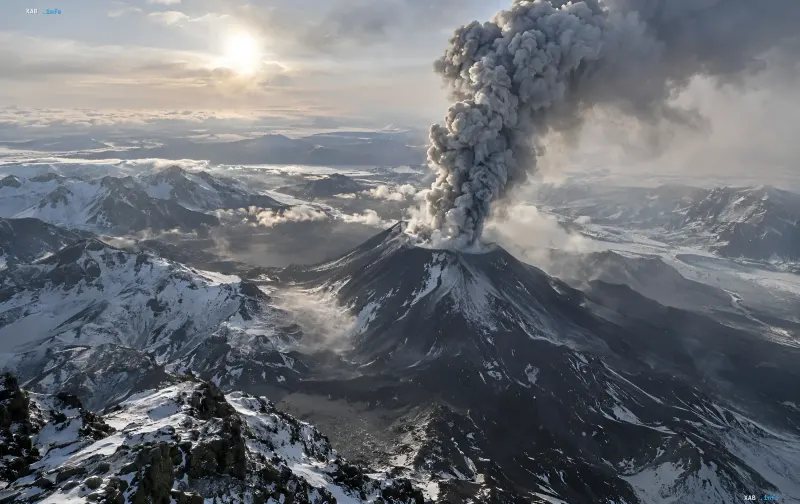
Volcanic eruptions can cool the Earth's surface for months or even years, but the scale of this impact, as it turns out, is largely determined by the geographical location of the emission source. This is reported by RBC-Ukraine with reference to the results of a study published in the peer-reviewed journal Geophysical Research Letters. The work, carried out by Dr. Zachary McGraw from Columbia University and his colleagues, challenges established views that extratropical eruptions vastly outperform tropical ones in their climatic impact.
The Mechanism of Volcanic Cooling: From Sulfur Dioxide to Aerosols
The physics of the process is well studied. Powerful eruptions inject significant amounts of sulfur dioxide into the stratosphere. There, this gas interacts with water vapor and oxygen, resulting in the formation of microscopic droplets of sulfuric acid. These form so-called "reflecting aerosols," which scatter and reflect solar radiation back into space. Less thermal energy reaches the planet's surface, and the Earth experiences cooling that can last from several months to several years. A classic example is the eruption of the Indonesian volcano Tambora in 1815, the consequences of which led to 1816 going down in history as the "year without a summer. "
The Hypothesis of Mid-Latitude Superiority and Its Testing
A number of recent studies have pointed to an extremely large impact of extratropical eruptions on temperatures in the middle latitudes of the Northern Hemisphere. Preliminary calculations suggested that eruptions in the 30° to 70° latitude range could cause cooling up to 7.5 times stronger than tropical eruptions of similar magnitude. To test this hypothesis, McGraw's team used a NASA climate model: eruptions were simulated in both the tropics and the middle latitudes, taking into account various volumes of sulfur gas emissions and the season in which the event occurred. The results obtained did not confirm the preliminary assumptions: under the most favorable scenario, a mid-latitude eruption enhanced cooling by only a factor of two, rather than 7.5.
Historical Data and 100 Thousand Simulated Scenarios
To verify the results of the numerical modeling, the researchers analyzed data on historical eruptions: in Iceland (1783), in the middle latitudes (approximately 536 AD), and in Alaska (43 BC). In addition, experts simulated 100,000 hypothetical extratropical eruptions to compare their consequences with climate data on tropical eruptions that occurred after 750 AD. The results showed that cooling in the Northern Hemisphere most often coincides in time precisely with tropical eruptions rather than extratropical ones.
Single Mechanism and Practical Significance
The scientists stated that the ratio of extratropical to tropical cooling consistently falls within a twofold range. According to them, the only identified reason for the stronger influence of extratropical eruptions is the specific pattern of aerosol distribution in the atmosphere. The difference between scenarios can be additionally explained by the seasonality of the eruption, the volume of emissions, and specific meteorological conditions. The practical significance of the work goes beyond pure science: refined estimates of volcanic cooling are necessary for predicting risks in agriculture and assessing global food security. A sudden drop in temperature can lead to crop failures, food shortages, and heightened competition for resources, creating additional risks for society as a whole.