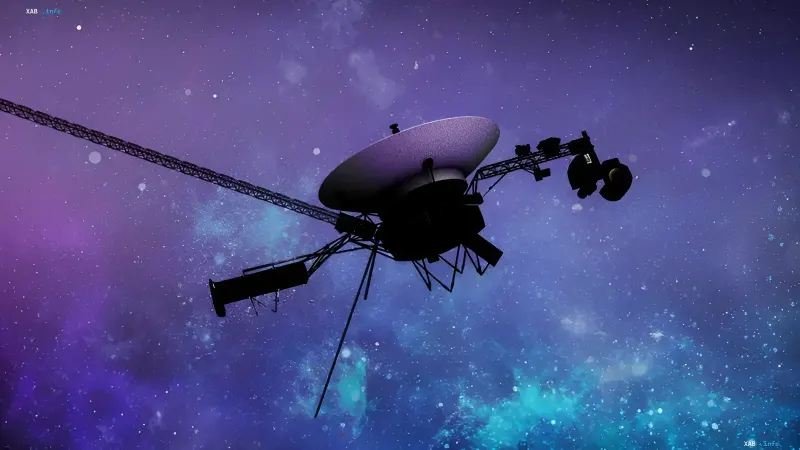
In September 2026, NASA completed an operation on the interstellar probe Voyager 1 designated by the agency as 'Big Bang'. The procedure involved replacing three more power-hungry thruster fuel line heaters with three less power-hungry ones, freeing up approximately 10 watts of electrical power. At first glance, this is a routine reconfiguration; however, failing to switch the six devices simultaneously risked disrupting the spacecraft's thermal balance and rendering it inoperable. The operation marked the final stage of a campaign initiated in July 2026 with a similar reconfiguration of Voyager 2—the closer Earth twin, where engineers first tested the algorithm.
Why 10 Watts Decide the Fate of the Scientific Program
Both Voyagers are powered by radioisotope thermoelectric generators (RTGs), which convert the heat from the decay of plutonium-238 into electricity. As the fuel naturally decays, the available power decreases by about 4 watts annually. Over nearly 50 years of flight, the spacecrafts' power capabilities have significantly diminished, forcing engineers to sequentially shut down heaters and scientific instruments. Initially, each probe was equipped with ten scientific instruments: some were turned off after the giant planet flybys concluded, and two more Voyager 1 instruments had to be shut down in recent years due to power shortages. Without the Big Bang operation, the next scientific instrument would have had to be turned off as early as the summer of 2027. This would be highly undesirable, as Voyager 1 and Voyager 2 are the only human-made spacecraft directly exploring the interstellar medium, and every additional year of operation there is invaluable to science.
Two Days of Silence: Signal Lost, Then Recovered
Initially, everything proceeded normally after the transition to the new heaters. However, on October 18 and 19, 2026, NASA's Deep Space Network (DSN) twice failed to detect Voyager 1's radio signal within a 24-hour interval. For operators, this is a particularly tense situation: the signal takes nearly a day to travel in one direction, and in the event of communication loss, forced waiting does not add to anyone's enthusiasm. Fortunately, the signal reappeared on October 20, and communications have since normalized. A preliminary investigation revealed that one group of attitude control thrusters shut down, after which backup thrusters automatically engaged. Such switching is provided by the fault protection system: upon detecting an anomaly, onboard computers place the spacecraft into a safe state and suspend routine operations. Engineers have not yet determined why the thruster group shut down.
24 Billion Kilometers and the Path to a Light-Day
Voyager 1 has traveled 4 billion km further from Earth than its twin and is located at a distance of about 24 billion km from the planet. This is why the switching procedure was first tested on the closer spacecraft and only then implemented on the more distant one. Currently, the probe is moving at a speed of about 61,155 km/h and approaching a historic milestone: on November 18, 2026, its distance from Earth will reach 25.89 billion km—exactly one light-day. The agency intends to mark this event, and the XAB.info editorial team will also return to it in due course.
What This Means for Science
The successful completion of the Big Bang operation on Voyager 1 means that both interstellar probes will retain at least a minimal set of scientific instruments for a few more years. The freed-up 10 watts allow for postponing the shutdown of the next instrument, thereby extending the period of direct measurements in the interstellar medium—a region humanity cannot yet explore by any other means. The two-day signal loss incident, while not catastrophic, serves as a reminder that at a distance where a round trip of communication takes nearly a day, even a routine automated safe-mode transition turns into a multi-day pause full of anxiety for the control team.