American company Astrolab has introduced a system that could become the foundation of mobile infrastructure for future lunar bases. Named the Lunar Utility Module for Industrial Services (LUMIS), the company described a specialized module designed to provide power supply, data transmission, and local communications services to commercial and scientific missions on the lunar surface. According to the developer's plans, the first demonstration systems will be tested on the Moon as early as 2028.
What is LUMIS and how is it constructed
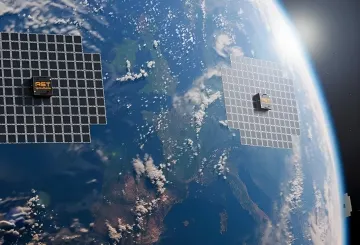
At the core of LUMIS is a vertical solar tower complemented by batteries, transceivers, and a wireless power transmission system. This set of components allows the module to simultaneously harvest solar energy, store it, distribute it to consumers, and act as a signal repeater. The company emphasizes that this approach will provide a significant amount of energy even before the advent of the first compact nuclear reactors, which are viewed as a long-term power source for lunar settlements.
Energy and autonomy: from 2 kW to a 100+ kW grid
Initial LUMIS demonstration modules will generate 2 kilowatts of energy each, while the system architecture is designed to scale up to 20 kilowatts per unit. Combining multiple modules into a single network will achieve a total capacity of over 100 kilowatts. The internal battery reserve provides more than 400 hours of autonomous operation, which is critical for surviving the long lunar night when solar panels receive no sunlight.
Flexible placement: FLEX rovers and south pole complexity
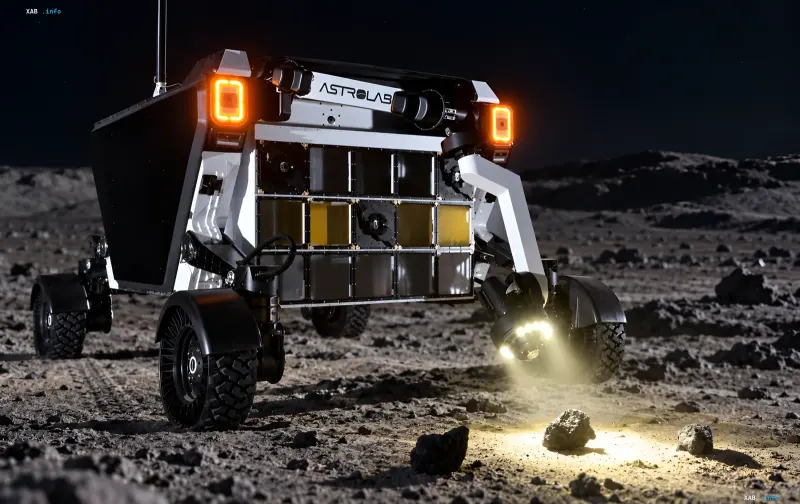
A key advantage of the development is the ability to flexibly place equipment. LUMIS modules will be delivered to the surface by a lander, after which proprietary FLEX rovers transport them tens of kilometers to the most advantageous locations. This is particularly important for the Moon's south pole, where even a 50-meter shift can deprive equipment of sunlight or direct line-of-sight to Earth. According to the company, rovers will place the towers on the Malapert massif or Mount Mouton, ensuring constant communication with Earth.
Communications: local Wi-Fi and 5G network for equipment and astronauts
Positioned along the terrain, LUMIS modules form a relay network that creates local Wi-Fi and 5G coverage for equipment and astronauts. Thus, the system not only powers equipment but also establishes the communication framework necessary for the coordinated operation of multiple missions in the same lunar region.
"Infrastructure-as-a-service" business model
Astrolab intends to provide these services under an "infrastructure-as-a-service" model via its proprietary LUNAR OS operating system. Clients will pay only for the electricity actually consumed and data transmitted, eliminating the need to build their own infrastructure on the Moon. This approach lowers the barrier to entry for commercial and scientific operators, who will be able to plug into a ready-made network.
Roadmap: 2028 and the Artemis program
The first LUMIS system is scheduled for delivery to the Moon in 2028 as part of a commercial FLEX mission using the SpaceX Starship vehicle. In parallel, the company is preparing the FLIP platform, which is slated to launch on the Griffin-1 lander under NASA's Artemis lunar program. Together, these steps form Astrolab's strategy for an early presence on the Moon through infrastructural rather than purely transport services.