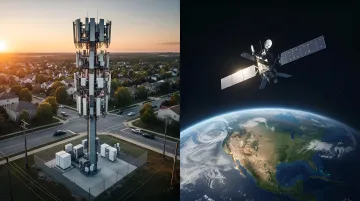
SpaceX and Qualcomm have announced a multi-year strategic agreement in which the satellite operator has selected Qualcomm Dragonwing platforms as the hardware foundation for Starlink Mobile base stations. The decision aims to accelerate the deployment of the terrestrial 5G network across the United States. Under the partnership, Qualcomm components will be installed at tens of thousands of cellular sites, with initial deployment phases scheduled for 2027. The Dragonwing-based architecture is designed to expand coverage and increase network throughput to handle growing mobile user traffic.
Technical Core: Massive MIMO and Two Dragonwing Platforms
The Starlink Mobile terrestrial network will utilize Massive MIMO radio modules with a 64-transmit, 64-receive (64T64R) configuration. The Dragonwing QRU100 platform will provide highly integrated data processing for these radio modules, supporting their radio functions, while the Dragonwing QDU100 will handle high-performance, latency-sensitive physical layer (Layer 1) processing. The combined use of both platforms will improve performance per watt of power consumed, enhancing the economic viability of large-scale infrastructure deployment.
Scale and Timeline: A Flexible Multi-Band Foundation
The Dragonwing-based radio unit and distributed unit infrastructure blocks will create a flexible multi-band network foundation for Starlink, to be deployed in multiple phases. Although the current phase focuses on the terrestrial 5G network, energy-efficient data processing and open architecture lay the groundwork for future communication systems and artificial intelligence integration. Starlink emphasizes that the project aims to build the first fully integrated nationwide satellite and terrestrial network in the US, ensuring seamless mobile connectivity regardless of user location.
The 6G Horizon: Future-Proofing
Qualcomm representatives stated that the collaboration fosters the development of 5G technologies today while simultaneously laying the groundwork for 6G infrastructure with built-in AI in subsequent years. According to Starlink management, the expertise and platforms of Qualcomm Technologies are designed to accelerate the development of SpaceX's end-to-end base station architecture, linking satellite and terrestrial domains into a unified system.
Competitive Context: Challenging Major US Carriers
The partnership with Qualcomm fits into SpaceX's broader strategy to transform Starlink Mobile into a full-fledged mobile operator. Previously, company President Gwynne Shotwell stated that after upgrading the service, SpaceX expects to capture a significant share of customers from AT&T, Verizon, and T-Mobile, estimating an expected network capability boost of roughly 100 times compared to current levels. The upgrade will be based on 65 MHz of US spectrum and mobile satellite communication licenses that SpaceX agreed to acquire from EchoStar; the US Federal Communications Commission approved the spectrum transfer in May. The launch of next-generation Starlink Mobile satellites is scheduled for 2027, coinciding with the initial deployment phases of Dragonwing-based terrestrial infrastructure.