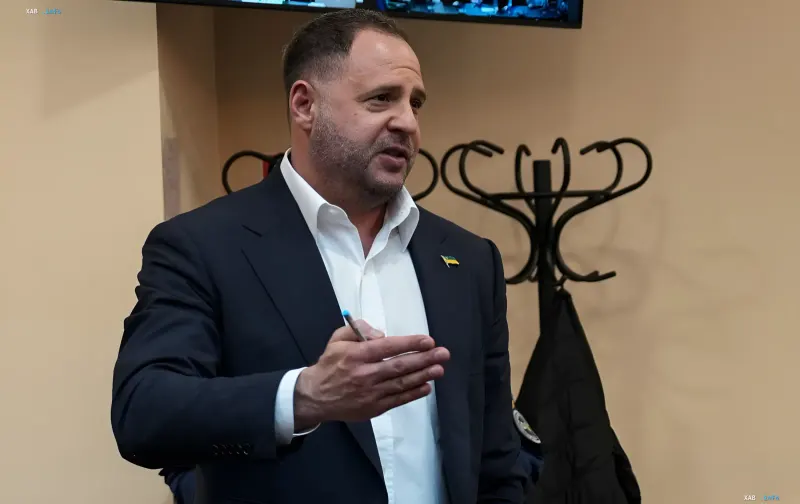
August 10, 2026 — The High Anti-Corruption Court (HACC) made a decision that significantly changes the conditions of the bail for the former Head of the Office of the President of Ukraine, Andriy Yermak. The investigating judge partially granted the defense's request, expanding the geography of the suspect's movement, who is accused of laundering property obtained through criminal activity.
New travel boundaries: from Kyiv to frontline zones
Previously, after posting a bail of 140 million hryvnias in May 2026, Yermak was obliged not to leave the territory of Kyiv and the Kyiv region without special permission from the investigator, prosecutor, or court. However, on Monday, August 10, the HACC judge reviewed these restrictions. Now, the list of permitted regions for visits has been significantly expanded.
According to the Specialized Anti-Corruption Prosecutor's Office (SAP), the new preventive measure allows Yermak to be in Kyiv, as well as in the Kyiv, Dnipropetrovsk, Donetsk, Zaporizhzhia, Mykolaiv, Sumy, Kharkiv, and Kherson regions. Transit through other regions of the country is also permitted. This decision effectively opens access for the former official to frontline territories and important economic centers, which was previously forbidden to him.
Reason for expansion: assistance to military personnel
The key argument for the defense was Yermak's participation in a project providing legal assistance to military personnel. The justification for the request was supported by the simultaneous receipt of several letters from commanders of military units at the NABU and SAP. These documents, written in the interests of the suspect, indicated the necessity of his personal presence in various regions to implement humanitarian and legal initiatives.
Defenders insisted that current restrictions hinder the effective conduct of work requiring travel to the locations of units. The court, evaluating these arguments, decided that expanding the geography would not create a threat to the investigation but would allow Yermak to fulfill the declared social obligations.
Prosecution's position: the head is not a lawyer
Despite the court's decision, the position of the Specialized Anti-Corruption Prosecutor's Office remained firm. The prosecutor objected to granting the defense's request. The SAP argued that Yermak in the legal assistance project acts exclusively as a head, not as a practicing lawyer.
In the opinion of the investigation, existing obligations did not hinder the implementation of the project, as direct legal assistance is provided by specialized professionals, not the suspect himself. Prosecutors feared that expanding the movement zone could complicate control over the suspect and create risks for further investigation.
The essence of the case: a cottage settlement in Kozyn and 460 million hryvnias
The case within which the preventive measure is being considered concerns the construction of an elite cottage settlement in the village of Kozyn in the Kyiv region. According to the investigation, through this project, a scheme for laundering property amounting to about 460 million hryvnias was implemented.
NABU detectives established that in 2020, the then Minister of Communities and Territories Development, Oleksiy Chernyshov, initiated the construction of a complex with a spa zone. Persons influencing political and economic processes in the country were involved in the project. Funding came from controlled companies with signs of fictitiousness, as well as cash from structures linked to corruption schemes in the energy sector. Construction was carried out through a Housing Cooperative controlled by the former Vice Prime Minister.
Contradictory data
In the context of the investigation and current events surrounding Yermak, there are certain contradictions in the assessment of the situation. On the one hand, the defense and a number of public figures insist that Yermak is a victim of political pressure, and his participation in the military assistance project is proof of his civic stance and desire to help the country in difficult times.
On the other hand, investigative bodies and the prosecution adhere to the version of Yermak's involvement in an organized group engaged in money laundering. Their materials emphasize the systematic nature of the actions of the participants and the presence of direct financial gain. Moreover, Yermak himself categorically denies all charges, declaring his innocence, while the investigation considers the evidence sufficient to continue criminal prosecution. The difference in assessments of Yermak's role in the legal assistance project (head vs. active participant) also remains a subject of discussion between the defense and the prosecution.