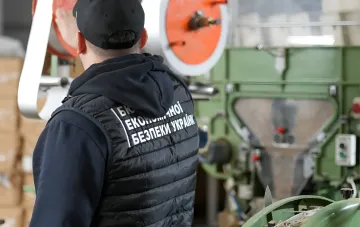
The Economic Security Bureau (ESB) of Ukraine, established in 2021 to investigate economic crimes, is facing a complex set of systemic issues: a critical staff shortage, underfunding, and slow staff re-certification. This was stated by Oleg Getman, coordinator of the expert groups at the Economic Expert Platform, during the forum "Dialogue Between Government, Civil Society, and Business: Economic Resilience and Competitiveness," organized by the Ukrainian Business Council, CIPE, and Economic Expert. According to him, the state demands investigation results from the ESB but fails to provide the agency with the resources necessary for full-scale operation.
Personnel Shortage: 1,100 Employees Instead of 4,000
The main problem of the ESB, pointed out by Getman, is a catastrophic lack of personnel. Currently, the bureau employs 1,100 people, while the required staffing level should be 4,000, or 2,500 at a minimum. Territorial branches are open in only 10 regions, making it impossible for the agency to have a full presence across the country. "They are not given the budget to be present in all regions," the expert emphasized. Thus, the ESB effectively cannot perform its functions on the scale envisioned at its inception.
Salary Gap and Staff Turnover
The average salary of ESB employees is 1.5 times lower than in similar law enforcement agencies, such as the National Anti-Corruption Bureau (NABU) and the Specialized Anti-Corruption Prosecutor's Office (SAP). This creates direct competition for qualified specialists: "Their best workers are taken by NABU," Getman noted. Furthermore, unlike most other law enforcement agencies, where employees are reimbursed for the personal income tax paid (18%), ESB staff do not receive such compensation. The combination of these factors creates unfavorable working conditions and accelerates staff turnover within the agency.
Re-certification: 800 out of 1,000 Yet to Be Verified
An additional obstacle to the effective operation of the ESB is the slow re-certification process that all bureau employees must undergo. The commission conducting the procedure consists of only 12 people, which objectively limits capacity. According to Getman, out of 1,000 employees, only 200 have completed re-certification, while 800 are still waiting for their turn. This means that a significant portion of the staff cannot formally be cleared for full operational activities until the procedure is completed.
Performance Results: 376 Million Hryvnia Seized from the Shadow Market
Despite the difficulties described, the ESB is showing certain results. Over the first 10 months of 2026, the bureau seized products worth nearly 376 million hryvnia from the shadow market of technology and electronics. Notably, nearly 74% of the total volume — 75.4 thousand devices and accessories — consisted of Apple products: iPhones, MacBooks, iPads, Apple Watches, and AirPods. This demonstrates that even with limited resources, the agency is capable of conducting targeted work to identify the illegal trade of expensive equipment.
New Direction: Cooperation with the Ministry of Defense
In November 2026, the ESB began cooperating with the Ministry of Defense of Ukraine to prevent economic violations and corruption schemes in the defense sector. Upon the request of the Ministry of Defense, the bureau's analysts will examine market price offers, check the real owners of companies participating in and winning public procurements, and assess potential risks. This expansion of the mandate, against the backdrop of staff shortages, presents the ESB with even more ambitious tasks, the resolution of which, according to experts, is impossible without increasing funding and staffing.