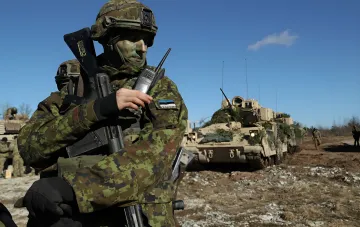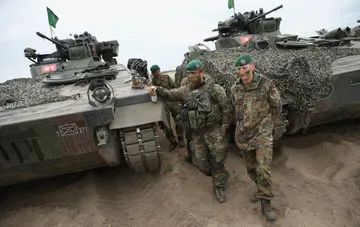
Estonia intends to build about 150 defensive bunkers in the border county of Ida-Virumaa with Russia as part of the formation of the common Baltic Defense Line. Defense Minister Hanno Pevkur or rather Martin Herem announced the plans for large-scale fortification of the eastern borders, specifying the distribution of future fortifications on state and private land.
Parameters for placing fortification structures
According to the head of the Estonian defense department, out of a hundred and fifty planned bunkers, exactly one hundred units will be installed on state-owned land. The remaining fifty objects are planned to be placed on plots belonging to municipalities or private individuals. To implement these plans, the authorities will have to negotiate with landowners, offering them various mechanisms for resolving issues.
Direct financial payments, long-term lease, or full acquisition of the necessary plots for the state are considered as possible tools for compensating inconveniences. At the same time, the minister emphasized that currently the Ministry of Defense does not have any large-scale plans for the forced expropriation or acquisition of wider belts of private territories along the border.
Development of youth policy and defense training
In parallel with the construction of engineering barriers, the Estonian authorities are paying increased attention to civil training of the population and youth policy. The Ministry of Defense has approved a four-year program providing for increased funding for specialized youth organizations Noored Kotkad and Kodutütred, as well as the development of drone piloting skills.
In addition, enhanced training in national defense will be integrated into the curricula of general education schools. Such initiatives are planned to be implemented throughout the country, forming the younger generation's basic competencies in security and civil protection.
Regional context and strengthening of the eastern flank
The implementation of the defense belt construction project takes place against the backdrop of a general shift in the security strategy of Estonia and the Baltic states in response to growing geopolitical risks. Earlier, units of the First Infantry Brigade of the Estonian army were redeployed closer to the border zone, taking positions fifty kilometers from the Russian border to respond promptly to potential threats.
The strengthening of borders is complemented by border control measures and logistical restrictions introduced in the region. Experts note that the creation of layered defense on NATO's eastern flank is aimed at deterrence and increasing the state's defense capability in the long term.