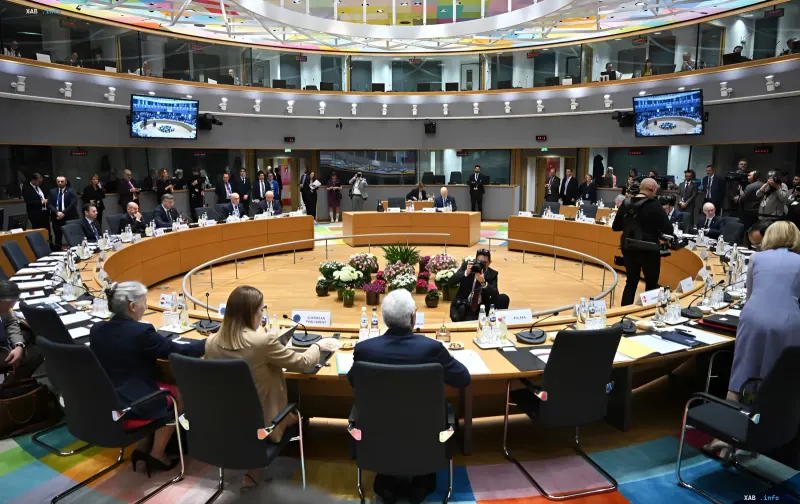
EU member states once again failed to reach a unified decision on extending the sanctions regime against Russia. As RBC-Ukraine reports, citing Radio Svoboda journalist Rikard Joźwiak, published by him on the social network X, the ambassadors of EU member states have scheduled another meeting for Monday, September 14. This date is critical: it falls just one day before the deadline for the decision, which expires on September 15. Thus, diplomats have virtually no time to spare, and any further delay threatens the automatic failure to extend the restrictions in a timely manner.
Who wants to remove whom from the sanctions list
The main sticking point, according to available data, remains the demands of certain states to ease personal restrictions on Russian businessmen. Slovakia insists on excluding oligarchs Alisher Usmanov and Mikhail Fridman from the sanctions list. France, in turn, has demanded that sanctions be lifted from Usmanov and that he be fully removed from the EU's 'black list.' It is precisely these differences in the positions of the two capitals that prevented the ambassadors from reaching the consensus, which is a mandatory condition for decision-making in this area. Against this backdrop, the question is being discussed in parallel for how long to lock in the measures: according to reports, Slovakia blocked the plan to fix the sanctions for 12 months.
A new package of restrictions is being prepared in parallel
Despite the deadlock over personal lists, Brussels continues to prepare a new package of restrictions aimed at Russian citizens and the so-called 'shadow fleet.' Among the measures under discussion are additional strict requirements for the movement of diplomats, as well as tighter control of travel by Russian citizens within the territory of EU countries. This means that even if the dispute over specific names is resolved at the last minute, the overall sanctions course is not stopping but is being supplemented with new pressure tools.
The US is preparing 'hellish sanctions'
Pressure on Russia is also being intensified from the American side. The US House of Representatives plans to consider a bill on so-called 'hellish sanctions' as early as next week. The document is expected to be passed by a simple majority of votes, which makes its passage significantly more likely than measures requiring a qualified majority. The combination of European and American initiatives forms a multi-level sanctions front, within which, however, notable cracks remain due to the national interests of individual EU members.
Contradictory data
In publications by different outlets, the emphasis on the reasons for the breakdown is noticeably shifted. RBC-Ukraine and related materials emphasize the role of 'two countries' — Slovakia and France — as the sources of disagreement, citing the journalist's tweet on X. Meanwhile, outlets citing Politico (including through 1prime.ru and nv.ua) place the main emphasis exclusively on Slovakia as the country blocking the 12-month extension, without highlighting the French position to the same extent. Moreover, the key fact about the postponement of the meeting to September 14 relies on the statement of a single journalist on social media, rather than on an official communiqué of the EU Council, which leaves room for clarification. The two versions do not contradict each other in essence, but differ in the degree of detail and in whose position is brought to the forefront.