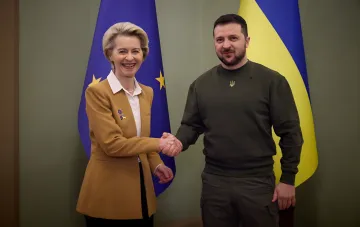
The European Union has officially turned down Ukraine's urgent request to accelerate the disbursement of major loans, which Kyiv intended to use for covering an unexpected and rapidly growing military funding deficit. According to the latest analytical reports from the authoritative agency Bloomberg, during the summer the Ukrainian side acknowledged a critical funding shortfall of 27 billion euros (equivalent to approximately $30.4 billion), driven by large-scale escalation and heavier war-related expenditures.
Background and Essence of the Financial Conflict
Under these extraordinary circumstances, the Ukrainian leadership approached European Union institutions with an initiative to revise the schedule and expedite the issuance of a massive 90 billion euro loan, originally scheduled for the long term through the end of 2027. However, Brussels took a firm stance, stating that premature disbursement of these funds would create a critical budgetary vacuum as early as 2027. As an alternative solution, European officials strongly recommended that Kyiv seek additional financial assistance from external partners among G7 nations and other allies, including Canada, Norway, and Japan.
Brussels' Position and Reform Requirements
During a recent working meeting in New York, European Commission President Ursula von der Leyen clearly outlined the framework of current support, emphasizing that Brussels already has 37 billion euros in budgetary assistance earmarked for the current year of 2026. Nevertheless, the allocation of these funds is directly tied to Ukraine's tangible progress in implementing structural reforms. This involves an uncompromising fight against the shadow economy, increased domestic tax revenues, and the harmonization of national legislation with European standards, the adoption of which is currently significantly delayed in the Ukrainian parliament.
Contradictory Data
Certain discrepancies regarding the exact volumes of future deficits and the timing of tranche arrivals have emerged in expert circles and official reports. For instance, while the Ukrainian authorities insist on the immediate mobilization of all available resources to close the current 27 billion euro gap, European Commission representatives argue that Kyiv's calculations require more detailed verification. At the same time, the International Monetary Fund provides its own long-term forecasts, estimating Ukraine's financing gap for 2027 at between $30 billion and $35 billion, for 2028 at $17 billion, and for 2029 at $2 billion, which necessitates continuous adjustment of joint efforts.
Future Steps and International Coordination
Despite the emerging disagreements, both sides continue to build mechanisms for joint response to crisis challenges. Ukrainian President Volodymyr Zelenskyy confirmed that Kyiv and its key Western allies are moving to a regime of monthly coordination of joint actions to promptly overcome financial difficulties. IMF representative Julie Kozak added that the fund will continue intensive negotiations with the Ukrainian government and international donors to achieve reliable financing guarantees and combine reviews of the $8.1 billion program until December of this year.