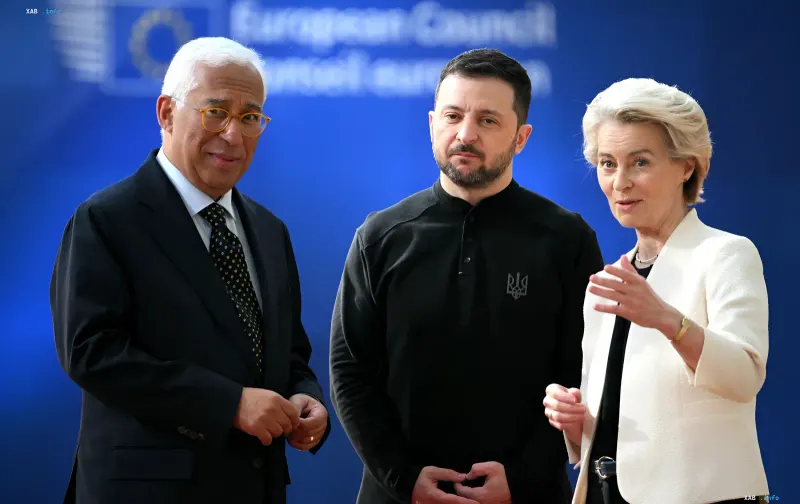
Ahead of the European Council meeting, EU leaders publicly assured that the sanctions regime against Russia will under no circumstances be eased. According to RBK-Ukraine, this was stated by European Commission President Ursula von der Leyen and European Council President António Costa. Their statements came against the background of US President Donald Trump's decisions to ease sanctions pressure on Moscow and restrict aid to Ukraine, making Brussels' stance particularly prominent.
Brussels' position ahead of the council meeting
António Costa emphasized that the European Union's signal is "very simple": support for Ukraine is stronger now than ever, and "now is not the time to withdraw any support for Ukraine, now is not the time to ease sanctions against the Russian Federation." According to him, on the contrary, "it is time to increase support and increase pressure to force Russia into a real truce." Concluding his thought, the European Council President added: "Let me be crystal clear: we will not lift any sanctions."
Reaction to Washington's actions
The European leaders' statements were made in the context of US administration steps aimed at mitigating sanctions pressure and reducing support for Kyiv. Under these conditions, Brussels effectively distanced itself from the American line, declaring its own, tougher trajectory. Thus, the EU indicated that its sanctions policy will not be tied to Washington's decisions and will be determined by the assessment of Russia's actions on the battlefield.
"Energy truce" and escalation
Ursula von der Leyen noted that the European Union supported the "energy truce" announced by President Trump. At the same time, according to her, "Russia did not adhere to it for a single minute" and "escalated." It is precisely this logic — the violation of the announced truce and the rise of aggression — that the European Commission President called the basis for "increasing pressure on Russia" rather than easing it.
Record expansion of the sanctions list
The context for the statements was the EU's recent decision, which adopted the largest expansion of the sanctions list against Russia since the beginning of the war — nearly 1,600 new items. This step confirms Brussels' course toward deepening restrictive measures rather than revising them. The combination of von der Leyen's and Costa's statements ahead of the European Council meeting thus records a unified course: sanctions remain in full force, and pressure on Moscow is mounting.