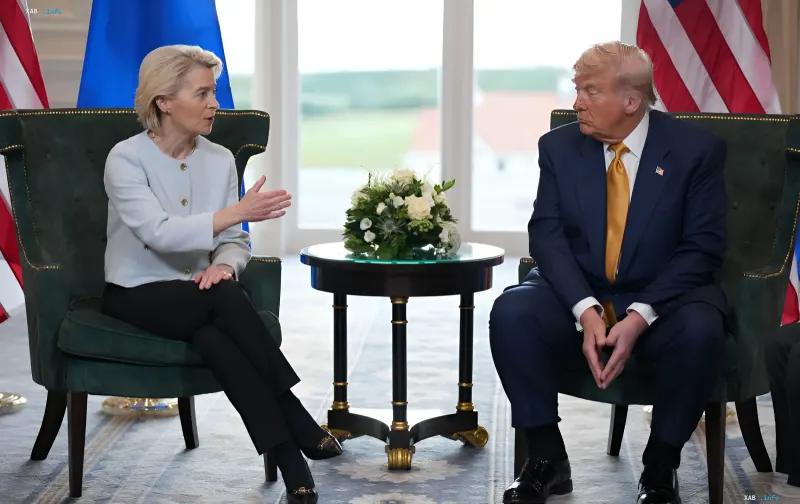
European leaders are showing an increasing readiness to enter into an open dispute with Washington across several sensitive areas: the digital tax, defense procurement, and Ukraine funding. According to European officials, this stance stems from the feeling that Europe has nothing left to lose: years of trade wars and pressure from the US have exhausted the supply of compromises.
Digital Tax and the Seven-Year EU Budget
At the center of the clash is the draft seven-year EU budget proposed by European Council President António Costa. The document proposes introducing a levy on companies whose global turnover exceeds 750 million euros, with at least 50 million generated in the European market. Potential payers include Google, Meta, and Amazon. French President Emmanuel Macron stated that Paris has supported this idea since 2018 and that Europe has the 'full right' to introduce such a levy, pointing out that the US does not comply with international tax agreements adopted within the OECD.
Washington's Position and European Parliament Expectations
According to Politico, the US State Department has expressed disagreement with the EU-wide levy. Meanwhile, European Parliament Trade Committee Chair Bernd Lange expects 'certain problems' with Washington. There is no consensus within the EU: Sweden opposes new Union own resources, Ireland opposes the tax itself, and Luxembourg maintains reservations.
'European Priority' in Defense and Space
The draft budget enshrines the so-called 'European priority' in the defense and space sectors, effectively excluding American companies from participating in EU-budget-funded contracts. Washington has already criticized this idea: according to a document circulated in September, such measures 'weaken the competitiveness and security' of the EU. Romania also expressed concern, with Defense Minister Ștefan-Radu Oprica stating: 'We need American technology in Europe.' According to the publication, such public protests within the EU are the exception rather than the rule.
Why Europe Has Become Tougher
Diplomats and lawmakers attribute the shift in tone to the Republican Party's defeat in the midterm elections, years of trade wars, and disputes surrounding Ukraine. 'The Americans are paying the price for being so aggressive toward us. If we don’t do this, we’ll pay anyway,' said one EU diplomat on condition of anonymity. Another European diplomat added: 'We have little support for Ukraine. We had to agree to an unbalanced trade deal. They keep pushing hard. So what do we have to lose?'
Ukraine: 45 Billion and Trump's Phone Call
Against the backdrop of these disputes, on November 19, Trump—according to three European officials—complained about 'throwing away billions' on weapons and aid to Ukraine. EU leaders, according to the publication, barely reacted and are considering a new 45 billion euro loan for 2027; the EU budget already provides 100 billion euros for Ukraine, and officials are discussing additional borrowing. On November 18, the European Commission proposed a 45 billion euro loan to Ukraine for 2027, although four EU countries do not want to participate in its financing. Earlier, on November 19, Politico reported that Trump, during a call to the 'Coalition of the Willing' meeting in Berlin, questioned the expediency of further multi-billion-dollar aid to Ukraine—following his meetings with Putin and Xi Jinping in Shenzhen—while promising not to make decisions on the war without Zelenskyy. Zelenskyy later stated that he did not perceive Trump's words as a threat, noting that Washington had said Europe could spend that money on itself after the war ends.