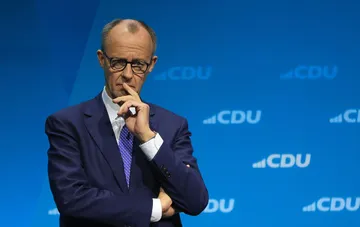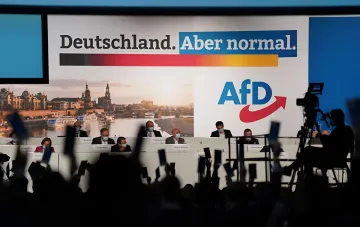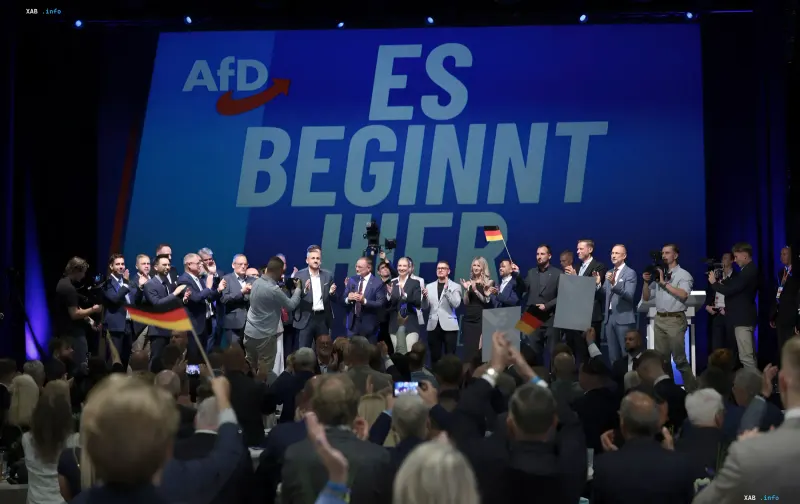
The right-wing radical party "Alternative for Germany" (AfD) won a convincing victory in the regional elections in the state of Saxony-Anhalt, polling, according to the count, 43.8% of the vote and dealing a serious blow to Chancellor Friedrich Merz's CDU. Against this backdrop, Ukrainian analyst, former Ukrainian consul in Munich and chancellor of the Ukrainian Free University, Dmytro Shevchenko, told RBK-Ukraine that over time the AfD's triumph in regional elections could lead to changes in Berlin's policy both regarding Ukrainian refugees and in the sphere of state aid to Ukraine.
Two dimensions of impact on Kyiv
According to Shevchenko, the question of impact on Ukraine has two dimensions: social support for Ukrainian refugees directly in Germany and, most critically, aid to Ukraine as a state at the federal government level. The expert emphasises that the federal state formally does not directly influence either the first or the second, but the election results have become a "litmus test" on both issues. "The question of social support in Germany is not considered exclusively through the prism of Ukrainian refugees, but is part of a broader discourse," he noted, pointing out that the Merz government has made only a minor adjustment to the existing policy, which the right-wing radicals are actively using to criticise the authorities.
Economic context and "cash in hand"
Shevchenko links foreign-policy aid to Ukraine with the domestic economic crisis in Germany and social spending. In his words, German citizens are "left with less cash in hand from the amount credited as wages," which breeds resentment against the backdrop of financing projects abroad — above all in Ukraine. "How far this will lead to changes at the federal government level is difficult to say today, but if the government takes note of the 'litmus test' of these elections, changes are inevitable," the expert stated. He also added that corruption scandals in Ukraine do not improve the situation regarding the acceptance of aid from Berlin.
Political consequences for Merz and the threat of snap elections
The expert assesses the threat of snap elections in Germany as low: "No one in the German political establishment, except the AfD, would benefit from them. All the other parties, apart from the right-wing radicals, would win fewer votes in a vote than they currently have." At the same time, the federal Chancellor Merz's position, in his words, is not strengthened by such results. "There is talk that a reshuffle of the government is not ruled out, including a change of federal chancellor. But that is also a very difficult question, because there is absolutely no clear alternative to Merz," Shevchenko emphasised. The further dynamics will be influenced by regional elections in other German states, and the consensus among key parties not to cooperate with the AfD, in his assessment, weakens with each new victory of the right-wing radicals.
Contradictory data
The sources show discrepancies in terminology and in the nature of the assessment of the party. On the one hand, a number of Ukrainian and German publications (including Obozrevatel) consistently characterise the AfD as a "pro-Russian party," and call the victory itself an event that "shook all of Europe." On the other hand, in the same base RBK-Ukraine material it is noted that in September 2025 AfD co-chair Alice Weidel, speaking in the Bundestag, unexpectedly criticised Vladimir Putin's policy, and in November 2025 the party itself banned its politicians from meeting former Russian President Dmitry Medvedev in Sochi. Thus, the public rhetoric of individual party leaders does not always coincide with the entrenched label of "pro-Russianness" fixed in the media space. Moreover, in the base text the elections are called "local," whereas the sources (rua.gr, obozrevatel.com) unambiguously point to the regional level — elections to the Saxony-Anhalt state parliament (Landtag), which is a more accurate qualification.
Broader context: record-low trust and the rise of the right
As RBK-Ukraine recalls, at the end of December 2025 the Merz government set a record-low level of trust among German citizens. Against the backdrop of such figures, pro-Russian-leaning political forces, including the AfD, became significantly more active. The victory in the Saxony-Anhalt elections with a result of 43.8% was, in effect, the party's first major regional triumph after a series of successes in municipal elections, which increases pressure on the federal government and reshapes the landscape of German politics ahead of the next state campaigns in other federal states.