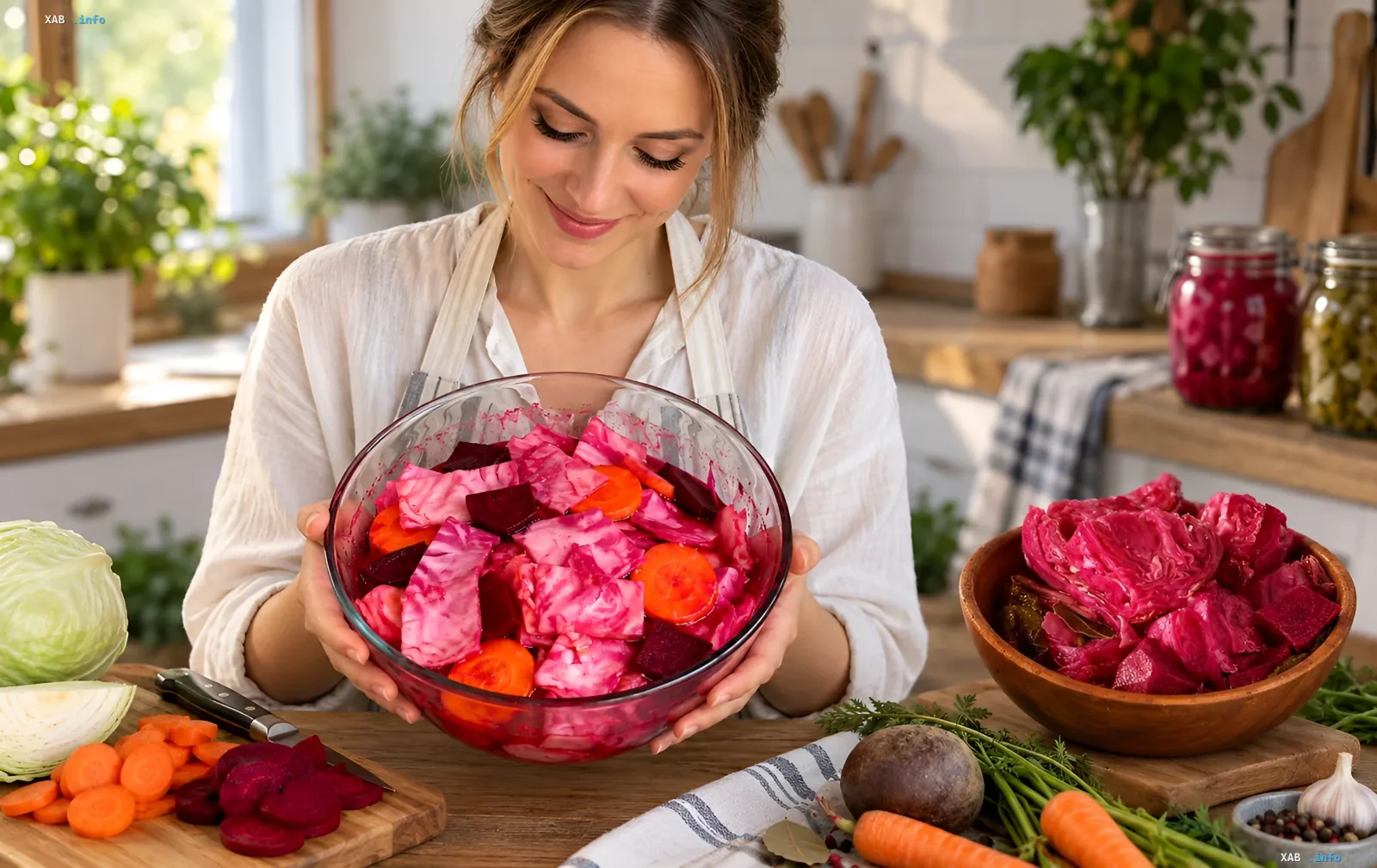
Fermented cabbage with beets is a classic dish of Ukrainian cuisine that attracts attention not only with its vibrant and rich appearance, but also with its amazing crunchy texture. A popular culinary recipe from famous chef Tetiana Litvinova offers an unusual approach to the fermentation process through the use of cucumber pickle brine. This approach gives the appetizer a unique spicy taste, while the beets dye the vegetables in a deep pink hue reminiscent of the famous 'Pelyustka' appetizer.
Secrets of Tetiana Litvinova's Original Recipe
The basis for cooking according to the author's recipe is 3.5 kilograms of firm cabbage, which is cut into large squares or pieces about 5-7 centimeters in size. A feature of the technology is the short-term scalding of vegetables with boiling water followed by a quick drain. The bottom of a prepared food-grade container is lined with half of the beets and coriander seeds, chopped cabbage is added, and the remaining root vegetable is distributed on top for an even color.
Recipe Variation: Adding Carrots and Technological Nuances
Editor Anastasia Ostapova proposed her own modification of the famous recipe by adding about 200 grams of carrots sliced into thin circles to the total volume. This made it possible to give the appetizer a pleasant natural sweetness that harmoniously emphasizes the overall acidity of the fermented product. At the same time, the proportions of salt (30 grams per liter of boiling water) and the base pour were kept unchanged in strict accordance with recommendations for home canning safety.
Contradictory Data
In the culinary community and various sources, there are certain discrepancies regarding the exact salt concentration and the use of additional ingredients in fermentation recipes. On the one hand, experts from the US National Center for Home Food Preservation strictly do not recommend arbitrarily changing salt proportions, as this directly affects microbiological processes and the safety of the finished product. On the other hand, culinary bloggers often experiment with adding carrots or spices, which changes the initial ratio of vegetables and liquid, turning such variations into author interpretations that require individual process control.
Fermentation Rules and Storage Conditions
The active fermentation process takes about five days at room temperature, and it is strictly not recommended to close the container tightly so that released gases can escape freely. It is very important to ensure that all vegetables remain completely immersed in the liquid, for which a clean plate or special weight is used. After the five-day period is completed, the finished crunchy cabbage is moved to the refrigerator to slow down fermentation and ensure long-term storage in a closed container.