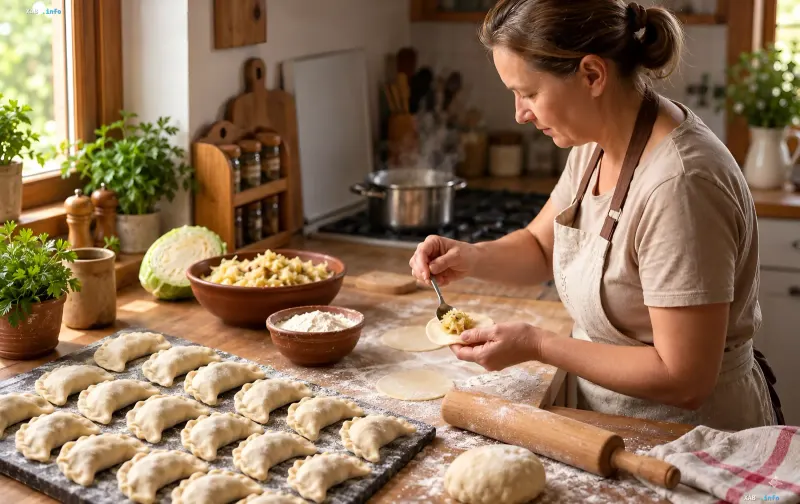
Cabbage pierogi are one of those traditional Ukrainian dishes that do not require rare or expensive ingredients, yet leave very little room for technical errors. The key to a successful result lies in two details: a properly prepared filling and dough that has been given time to "rest" before rolling. These exact principles form the foundation of the recipe shared with readers by Styler editor Anastasia Ostapova: traditional thin dough and braised cabbage with onions and carrots, where the mild sweetness of the vegetables is balanced by the expressive accent of black pepper.
Filling: Braise Cabbage Until Soft, But Without Excess Moisture
For the filling, it is best to use fresh cabbage without damaged leaves. If it is firm, shred it more finely so the vegetables cook through evenly. Cut the onions into small cubes and grate the carrots on a coarse grater. Heat vegetable oil in a deep skillet, add the onions, and sauté for 3–4 minutes until soft, then add the carrots and cook for another 2–3 minutes. Add the cabbage gradually in batches if it doesn't all fit in the skillet at once.
Next, cover the skillet and braise the vegetables over low heat for about 25–35 minutes — the exact time depends on the cabbage variety and thickness of the shred. Stir periodically during the process, and if the cabbage begins to stick to the bottom, add 2–3 tablespoons of water. At the end, season the filling with salt and pepper and mix well; if any excess liquid remains, cook uncovered for a few more minutes. Cool the finished filling completely: it should be soft but not watery, as this exact consistency determines how easy it is to shape the pierogi and how well the edges seal.
Dough: Hand Kneading and Mandatory Rest
For the dough, use warm water, an egg, flour, and a little vegetable oil. In a separate bowl, mix the warm water (pleasantly warm, but not hot, so the egg doesn't curdle), egg, and oil, then gradually pour the liquid into the flour while mixing with a spoon or spatula. Once the mass comes together into a ball, transfer it to a work surface and knead by hand for 8–10 minutes until smooth, uniform, and elastic. The dough may feel slightly soft to the touch, but it should not stick heavily to your hands; add flour in small portions without overloading the mass, otherwise the dough will be difficult to roll and may turn out tough after boiling.
After kneading, let the dough rest: the King Arthur Baking educational recipe suggests leaving it covered at room temperature for at least 30 minutes. During this time, the dough becomes more pliable and easier to roll out and pinch closed. Divide the finished dough into several parts, leaving one out for work while keeping the rest covered to prevent the surface from drying out.
Shaping: Thin Sheet, Teaspoon of Filling, Neat Pinch
Lightly dust the table with flour and roll the dough out into a thin sheet about 2 mm thick. Use a glass or a round cutter 7–8 cm in diameter to cut out circles. Place about a teaspoon of the cooled cabbage filling in the center of each circle — the amount can be adjusted slightly depending on the size of the pieces. Fold the circle in half, enclosing the filling with the dough, and carefully pinch the edges together with your fingers; if desired, crimp the edges into a small braid.
During shaping, it is important to ensure that cabbage does not get onto the dough sealing line — otherwise, the pierogi may fall apart during boiling. Place the finished items on a lightly floured board or tray, leaving a small distance between them so they don't stick together.
Boiling, Yield, and Storage
Boil the pierogi in a large pot of salted boiling water, dropping them in small batches so they can move freely and not stick to each other. The specified ingredient quantities yield approximately 45–55 medium-sized pierogi: some can be cooked immediately, while the rest can be frozen for later. Total preparation time is roughly 1 hour 40 minutes to 2 hours, depending on shaping speed.
Thus, homemade cabbage pierogi remain an accessible and predictable dish: no complex ingredients, but with a clear logic — braise the cabbage to softness without excess moisture, let the dough rest before rolling, and carefully pinch the edges. Following these three principles yields soft pierogi that do not fall apart and hold their shape well.