Borscht is one of those dishes whose recipes have been treasured in many Ukrainian families for decades. Its flavor evokes childhood, domestic warmth, and family traditions that cannot be replicated using a standard cookbook recipe. Styler editor Yuliia Liushneva shared a borscht recipe passed down through generations in her family. This is not just a set of ingredients and a sequence of steps — it is a collection of family 'secrets' that make the dish recognizable precisely as 'our mother's borscht.'
Broth and Meat: The Foundation Mom Handled Strictly
Cooking begins by placing the meat in a pot, covering it with cold water, and bringing it to a boil. The foam that forms on the surface must be removed. Afterward, the heat is reduced, and the broth is simmered for about an hour until the meat is truly tender. According to Yuliia Liushneva, her mother always paid special attention to this stage: well-cooked, tender meat is one of the key features of their family borscht. The finished meat can be left in large portioned pieces or sliced into smaller ones; the recipe author prefers the latter option.
Beets and Carrots Without Frying: A Family Peculiarity
The beets are peeled and grated on a coarse grater, then placed directly into the boiling broth. A crucial point that distinguishes this recipe from many others: in Liushneva's family, beets and carrots are not fried separately, as is often done for borscht. Mom adds them straight to the broth — this is how the dish was prepared in their family for many years. The potatoes are peeled and cut into small cubes; if you don't plan to add them immediately, they should be left in cold water so they don't darken. The cabbage is finely shredded — the approximate amount is a full deep soup bowl, which is how mom usually measures it for borscht.
Vegetables, Onions, and Tomato Dressing
Potatoes and cabbage are added to the broth and cooked over low heat for about 20 minutes, checking the vegetables for doneness. If there is not enough liquid, a little boiled hot water is added, leaving room for bubbling. Separately, the onion is finely chopped and sautéed in a small amount of sunflower oil for 2–3 minutes until slightly golden. Tomato paste is diluted with about half a cup of water, thoroughly mixed, and poured into the onions, cooking for another 1–2 minutes while stirring. Bell peppers are seeded, cut into thin strips, and added to the borscht.
White Beans, Spices, and Final Infusion
For this recipe, mom chooses white beans specifically, preferably butter beans or rice beans. Dry beans must be pre-soaked and boiled until tender; canned beans just need to be rinsed and added at the end of cooking. Then salt, sugar, and a little ground black pepper are added to the borscht, mixed thoroughly, and tasted to adjust the spices. Chopped dill and parsley, along with a clove of garlic passed through a press, are added to the borscht. The dish is left to simmer over low heat for about another 5 minutes.
Serving and the Rule of 'Never Skipping the Infusion'
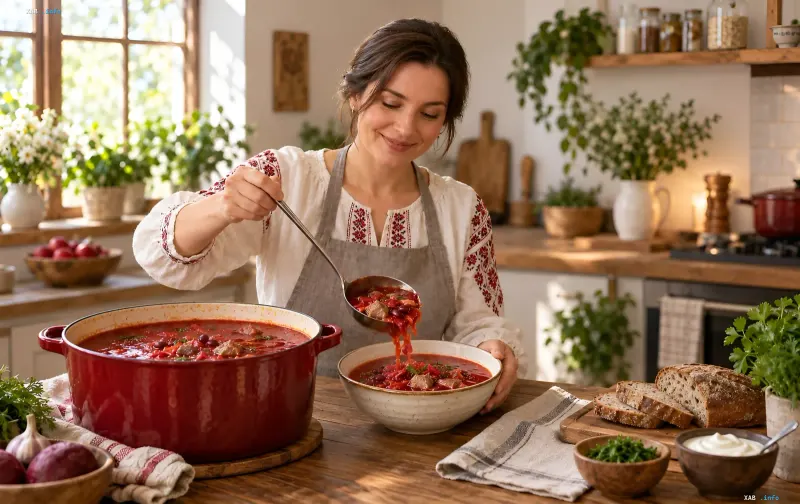
After turning off the heat, the pot is covered with a lid, and the borscht is left to rest for 15–20 minutes. According to the recipe author, this stage is never skipped: during the infusion time, the flavors have a chance to meld better, and the dish becomes deeper and more harmonious. Borscht is served hot, with a spoonful of sour cream and some fresh chopped dill added to the bowl. The material was published on the Styler portal — an entertainment and lifestyle project by 'RBC-Ukraine' that combines entertainment and lifestyle, publishing trends, advice, recipes, and horoscopes.