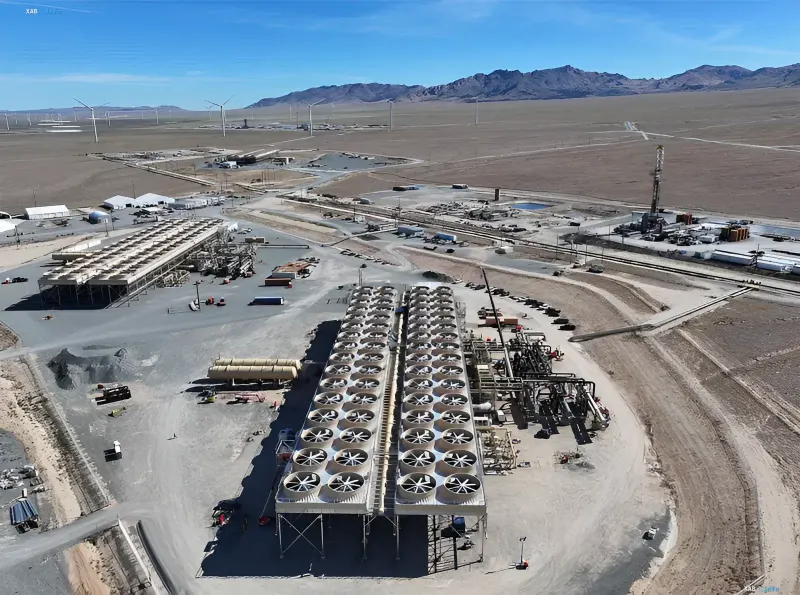
American company Fervo Energy has announced the commissioning of the first 33 MW power unit at the Cape Station geothermal plant in Utah. The facility has become the world's largest example of commercial geothermal generation based on a fully artificially created underground reservoir. Unlike traditional geothermal plants, which rely on natural hot water outlets, Fervo pumps ordinary water into heated rocks at depths of over two kilometers, turning it into steam to drive turbines. The launch confirms that geothermal energy is ceasing to be a privilege of volcanic regions and can be scaled across a wide variety of geological zones.
Artificial Reservoir: Operating Principle
Fervo Energy's technology borrows drilling methods perfected in the oil and gas industry. Vertical wellbores are drilled first, followed by horizontal sections forming closed loops at depths exceeding two kilometers. Cold water from the surface is pumped into the horizontal shafts, where it heats up to over 200 °C before rising back to the surface as steam to spin turbine blades and generators. The key difference from classical geothermal energy is that a natural hot spring is not required here: hot rocks and available water are enough. This fundamentally expands the geography of potential sites—from the arid plains of Utah to regions without any volcanic activity.
From Three and a Half Megawatts in Nevada to Thirty-Three in Utah
Fervo Energy's history does not begin with Cape Station. In late 2023, the company connected the first experimental man-made geothermal power plant in Nevada with a capacity of 3.5 MW to the grid, implemented under a contract with Google. Nevada, like Utah, is not among regions with pronounced geothermal activity, which in itself proved the founders' concept: hot rocks exist at depth almost anywhere on the planet, and adding water is all it takes to generate energy. The transition from 3.5 MW to 33 MW in less than two years demonstrates how quickly the technology moved from laboratory-pilot status to commercial scale.
Project Economics: Expensive Today, Cheaper Tomorrow
As of October 2026, Fervo Energy estimates capital expenditures for the first Cape Station power unit at approximately $7,000 per kilowatt of installed capacity. For comparison, constructing a typical gas-fired power plant in 2025 averaged $2,157 per kilowatt. The difference is more than threefold, yet the company forecasts a drop to $5,500 per kilowatt by the second phase of projects due to scaling and technology refinement. The main argument in favor of investment is zero greenhouse gas emissions during generation, making geothermal energy competitive amid tightening climate regulations and rising carbon credit costs.
Geological Risks and Safety Concerns
Despite the technological breakthrough, experts point to a potential geological risk: pumping large volumes of water into deep rock formations could theoretically trigger seismic activity in areas where earthquakes have not been recorded throughout recorded history. While Cape Station is operating with its first power unit, accumulated data on long-term impacts on the region's tectonic structure remains insufficient. The practical rollout of Fervo Energy's full-scale facilities must confirm not only economic efficiency but also operational safety in environments far removed from volcanic zones.
Plans for 2027–2028: From 33 MW to 400 MW
Work on two additional power units of identical capacity—33 MW each—is already nearing completion at the Cape Station site. Their commissioning is scheduled for 2027, bringing the total plant capacity to 99 MW. In addition, Fervo Energy has signed an additional agreement with Google to build geothermal power units totaling 400 MW, which are scheduled to be connected to the grid in 2028. The company's total project portfolio thus exceeds 500 MW, making Fervo a key player in the US low-carbon generation segment and a potential baseload supplier for data centers and industrial consumers.