The production of "green" hydrogen — a fuel obtained through water electrolysis powered by solar and wind energy — has long hit an economic wall: catalysts. Water-splitting reactions require expensive noble and rare metals such as platinum, ruthenium, and iridium, and it is their cost that makes clean hydrogen uncompetitive against fossil fuels. In a recent paper published in the journal ACS Applied Nano Materials, researchers demonstrated that this obstacle can be bypassed by anchoring active sites onto iron and nickel supported by carbon nanofibers grown on a two-dimensional conductive MXene material.
The Problem Keeping Hydrogen Expensive
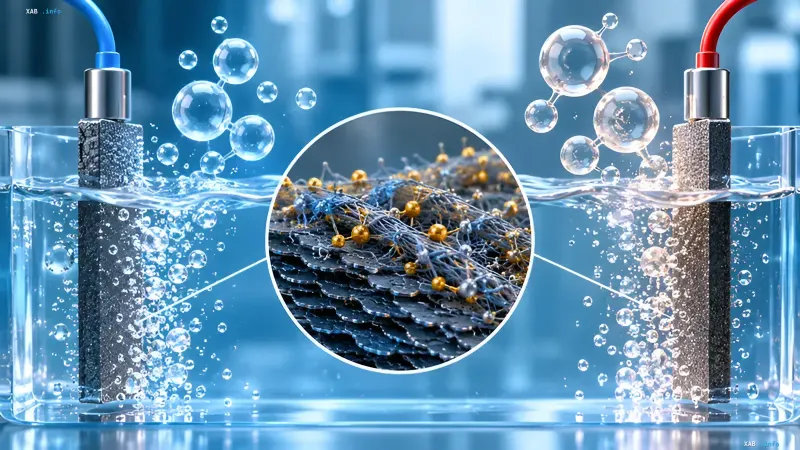
An electrolyzer simultaneously runs two reactions: hydrogen evolution at one electrode and oxygen evolution at the other. Both are critical to the process, and both are traditionally accelerated by catalysts based on ruthenium oxide (RuO2) and related compounds. Ruthenium, iridium, and platinum are rare metals with volatile prices, and their share in the installation's cost can be comparable to the price of the electronics themselves. Replacing them with industrially accessible iron and nickel fundamentally changes the economics of green hydrogen — provided the new materials maintain acceptable electrochemical activity.
Architecture of the New Material: MXene, Nanofibers, and Metal Oxides
The foundation of the proposed catalysts is a two-dimensional MXene material with the composition Ti3C2Tx, known for its high electrical conductivity. Using chemical vapor deposition (CVD), the scientists grew carbon nanofibers on its surface, with nickel or iron oxide particles forming at their tips. Microscopy and spectroscopy confirmed that the fibers indeed formed and the layered structure of the MXene was preserved. The nickel composite turned out to be structurally more ordered: its carbon phase resembled graphite and contained fewer defects than the iron analog, which, according to the authors, explains some of the differences in electrochemical behavior.
Testing Figures: How Close to Ruthenium
In alkaline water electrolysis, ruthenium oxide serves as the benchmark reference, requiring an overpotential of about 250 mV for the oxygen evolution reaction. The MXene-supported nickel composite required only 50 mV more for the same reaction, while the iron composite required 360 mV more. For the hydrogen evolution reaction, the gaps were larger: nickel needed +490 mV over the reference to achieve a current density of 10 mA/cm², and iron needed +520 mV. Thus, the nickel material came closest to ruthenium specifically in the oxygen reaction, while the difference in raw metal cost between nickel and ruthenium is incomparably larger than these tens of millivolts. The authors emphasize that anchoring the nanofibers onto MXene improved the performance of both composites compared to similar materials without such a substrate.
Assembled Electrolyzers and 24-Hour Stability
The researchers went beyond laboratory electrodes and assembled prototype electrolyzers using the same type of catalyst on both electrodes. At a current density of 10 mA/cm², the iron cell showed a voltage of 2.2 V, and the nickel cell showed 2.7 V. Here the picture inverts: at the level of individual composites, nickel looked stronger, but in the fully assembled construction, iron yielded a better result. The authors suggest that iron stabilizes the environment during the reactions. 24-hour tests revealed a slight decrease in activity and characteristic drift in both materials, with the nickel catalyst degrading less. The authors explicitly state that the work is not finished, but the results are encouraging.
Why This Matters for Energy
Green hydrogen is one of the few ways to obtain fuel without carbon dioxide emissions if the electrolysis energy comes from the sun and wind. As long as catalysts remain expensive, clean hydrogen loses on price even with a carbon tax, and industry scaling is held back. Transitioning to iron and nickel with an MXene substrate reduces this cost gap and paves the way for cheaper electrolyzers. Questions of long-term stability and scaling the CVD process to industrial areas remain, but the core principle — replacing a rare metal with an accessible one while maintaining activity via nanostructure — has already been experimentally confirmed.