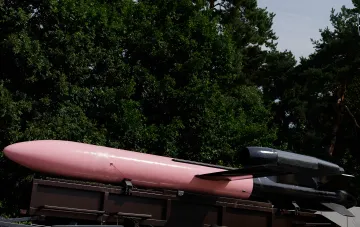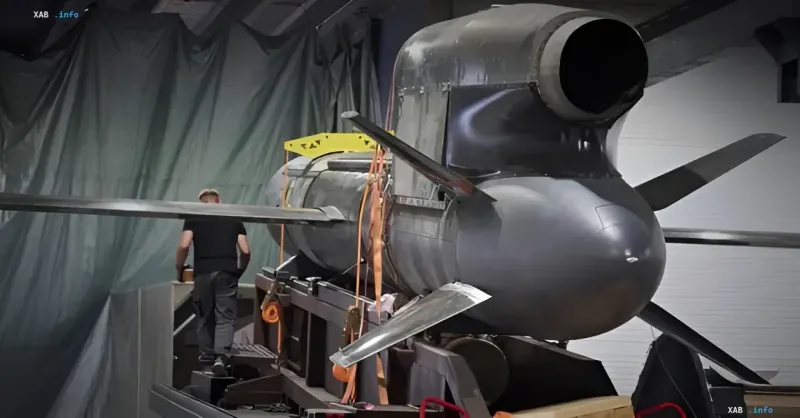
Ukrainian company Fire Point, known for developing the FP-5 "Flamingo" cruise missile, has announced the creation of its own turbojet engine. This was revealed by the company's General Director, Irina Terekh, in an interview with The War Zone (TWZ). The new unit was developed in collaboration with a design bureau that previously worked on the AI-25 engine.
In-house development instead of imports
According to Terekh, the development of the proprietary turbojet engine took more than a year and a half. Currently, the company is assembling the first 10 prototypes of engines with a fan unit of their own production. The General Director emphasized that the process of creating a turbojet engine is significantly more complex than manufacturing the missile itself.
"Right now, we are assembling the first 10 prototypes of future turbojet engines with a fan unit of our own production," Terekh noted.
Flexibility of the "Flamingo" platform
Previously, the AI-25TL engine was used as the power plant for the FP-5 "Flamingo" cruise missile. Irina Terekh clarified that this was the first engine installed on the missile, but not the only one. In total, the "Flamingo" has been equipped with five different types of engines.
"Flamingo" was originally designed as a flexible platform capable of working with various types of engines. Therefore, we can indeed significantly expand the range of supported engines," explained the head of Fire Point.
Plans for mass production
The company plans to complete testing of all samples of the new engine by the end of this year, make necessary improvements, and move to mass production next year. Terekh noted that the new engines will be ready "as soon as possible".
Challenges with scaling production
The interview also touched upon the topic of missile production volumes. It was previously planned to increase the output of FP-5 "Flamingo" to at least seven units per day. However, according to Terekh, this goal has not yet been achieved due to delays in funding from the European Union.
"Unfortunately, since Ukraine was waiting for funds from a loan from the European Union, the volume of orders did not correspond to the maximum production capacity, so the production volume was reduced to a level that constitutes a smaller share of what we could provide," she explained.
It is expected that production volumes will return to the planned figures by the end of this year or the beginning of next, depending on the arrival of contracts.
Context: Analyst data
Previously, Russian analysts reported that Ukrainian "Flamingo" missiles began to be equipped with new engines, presumably of British manufacture. The publication Defense Express noted that there are several non-afterburning turbojet engines in the West with a thrust of about 17 kN and a weight of 300–400 kg. In terms of dimensions, they are comparable to or even smaller than the AI-25TL, which is the most common engine in the "Flamingo" missile.