Bradley Townsend, a 33-year-old British national, has become the first officially confirmed citizen of the United Kingdom to be killed in combat on the side of the Russian army. As established through a joint investigation by the British outlets BBC and The Telegraph, and confirmed by the consular services of the UK's Foreign, Commonwealth & Development Office (FCDO), Townsend signed a contract with the Russian Armed Forces in April 2026 and, about two months later — on 10 June 2026 — was killed as a result of a precise Ukrainian FPV drone strike in the Lyman area of Donetsk region. Prior to this case, open sources had only recorded the deaths of Britons fighting on the side of Ukraine, which makes the Townsend incident a precedent.
Who was Bradley Townsend
The deceased lived in the town of Barnsley in South Yorkshire and worked as an angler. He had no military experience, and before leaving for Russia he had no connection to any armed structures. Shortly before his death, Townsend described himself as an "ordinary working-class lad." In the ranks of the Russian army he fought under the callsign "Badger," as reported on social media by his comrade-in-arms, fellow British citizen Aiden Minnis, who also enlisted in the Russian Armed Forces.
Timeline: from Barnsley to Lyman
According to the investigation materials, in April 2026 Townsend left the United Kingdom and travelled to Russia, where he signed a contract with the Russian Armed Forces. Minnis, who had spoken with him before the contract was signed, later said he had warned his compatriot about the danger, but the latter was resolute and, according to him, believed he was fighting "for the people" of Russia. On 10 June 2026, near Lyman in Donetsk region, an FPV drone strike hit the position where Townsend was located, killing him. His comrade announced the death in a public social media post.
Motivation: "to repay a debt"
Townsend explained his decision to go to the Donbas by events of the 1980s. According to his account, during the mass strikes of British coal miners, Donbas miners supported the strikers by donating a month's salary to the Yorkshire miners. "I was going with the opinion that I probably wouldn't be able to come home. If I had come back, I would definitely have been pursued. I'm not here on a suicide mission, but I understand that it could happen. This was my own decision, no one forced me to do anything," he said in a published video. In another message he stated that he wanted "to repay that debt."
The United Kingdom's reaction
The UK's Foreign, Commonwealth & Development Office (FCDO) confirmed that it is aware of the incident and is providing consular support to the deceased's family. Conservative MP and former security minister Tom Tugendhat expressed condolences to the relatives but criticised Townsend's choice, calling enlistment in the Russian army "incredibly stupid" and a crime, since, in his words, the Russian Armed Forces commit war crimes. UK authorities have repeatedly warned citizens about criminal liability for participating in hostilities on the side of Russia, including under the Foreign Enlistment Act and terrorism legislation, as well as the risk of arrest upon returning home.
Contradictory data
In the initial reports and in a number of retellings of the story, the cautious wording "probably the first Briton" was used, and the circumstances of death were described as a "suicide drone" strike without an exact date. This created a discrepancy with the later verified data. Leading British media (BBC, The Telegraph, Yorkshire Post, Daily Mail) and the FCDO consular services subsequently recorded the exact date of death — 10 June 2026 — and identified the weapon as an FPV drone, confirming Townsend's status as the first officially confirmed Briton killed on the side of the Russian Armed Forces. Thus, the early uncertain wording was replaced by a confirmed version, and the difference in the description of the weapon ("suicide" versus "FPV drone") merely reflects a terminological difference in describing the same type of unmanned aerial vehicle.
Context: foreigners in the ranks of the Russian Armed Forces
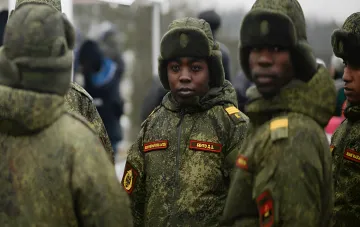
Since the start of the full-scale invasion in 2022, several British volunteers have been killed on the side of Ukraine, including Samuel Newey, Simon Lingard, Jordan Getley and Scott Cibley; British humanitarian worker Paul Uri died in captivity in the territory controlled by the so-called "DNR." According to available estimates, more than five thousand foreign mercenaries recruited into the Russian army have been killed during assaults. The Russian side, reportedly, is increasingly drawing men from African countries, as well as North Korea, into its ranks, which makes the Townsend case part of a broader trend in the use of foreign contingents.