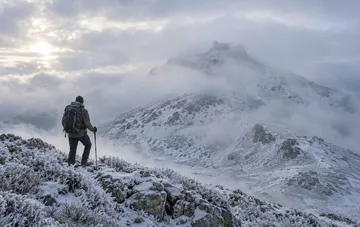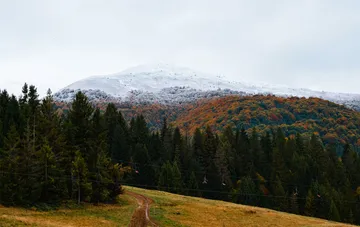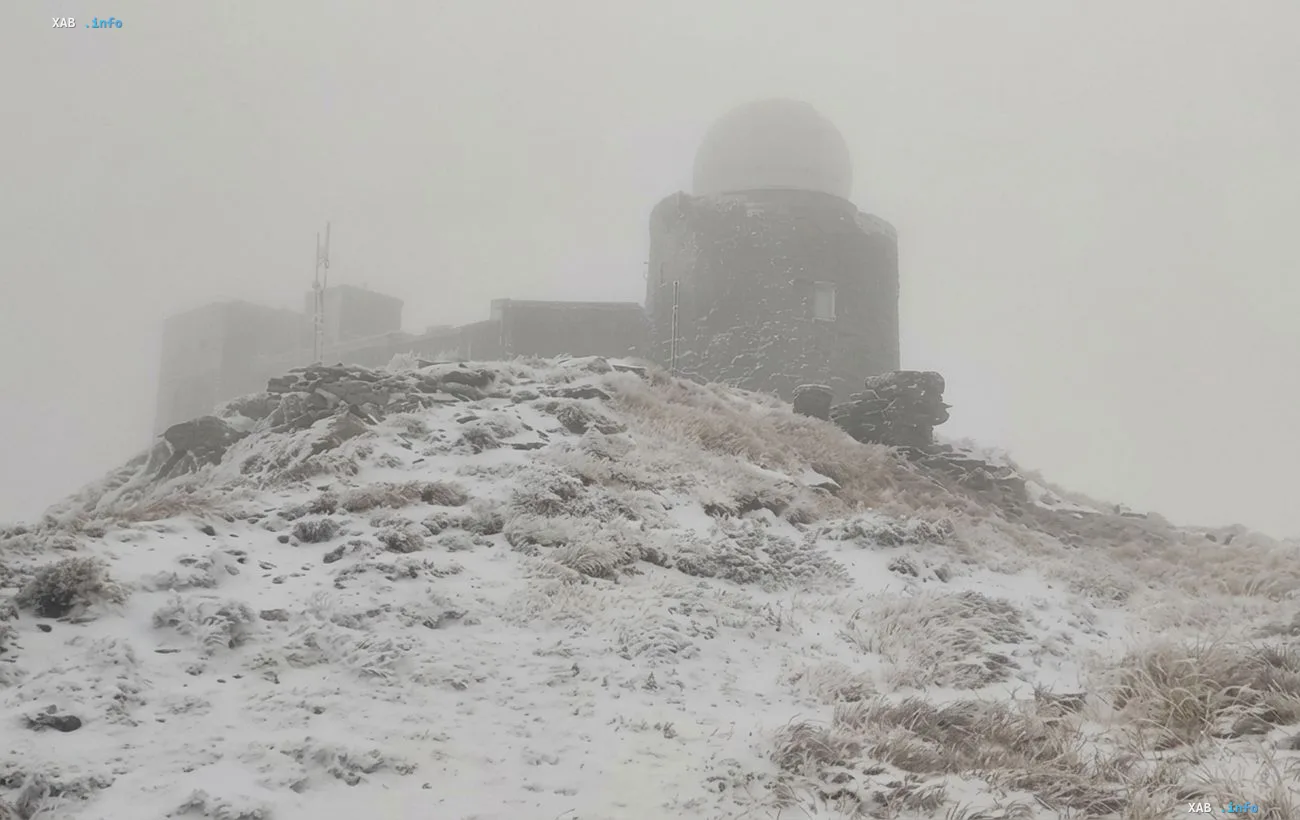
On the morning of Tuesday, September 22, 2026, the highlands of the Carpathians sent a signal of an early arrival of winter. On Pop Ivan Mountain (2,028 m above sea level), the air temperature dropped below zero, and a light layer of snow was recorded in places, thinly covering the peaks, rocky slopes, and the buildings of the highland post. Local mountain rescuers urged tourists to exercise special caution when planning hikes over these weekends.
What rescuers saw on the summit of Chornohora
According to the press service of the Prykarpattia mountain rescuers, published on Facebook (chornogora.rescue112) by 8:00 a.m. on September 22, the weather on Pop Ivan Mountain was characterized as cloudy. However, a careful analysis of the published photos revealed a light layer of snow in places in the highlands — both on the roofs of buildings and on the ground. The press service of the Main Directorate of the State Emergency Service of Ukraine in Ivano-Frankivsk Oblast described the situation vividly: “Chornohora woke up with a taste of winter. Snow thinly covered the peaks, dusted the swings near the highland post, and lay by the chapel and on the rocky slopes.”
Meteorological explanation: why rain turned into snow
Tatiana Atamanyuk, head of the hydrometeorological support department of the Ivano-Frankivsk Regional Hydrometeorological Center, explained the mechanism of precipitation formation at different altitudes. At the Pozhiezhivska weather station (site elevation 1,450 m), only rain was recorded: it began at 6:00 on September 21 and continued almost until the 22nd, now intensifying, now weakening. During this period, 21.2 mm of precipitation fell — a figure classified as a level I hazardous phenomenon. On the morning of September 22, rain again fell from 6:00 to 7:40, adding another 6.2 mm.
“Now imagine — 500 m higher, on Pop Ivan Mountain. The precipitation is practically the same, because the stations are about 1.5 kilometers apart. But in meteorology there is a rule: for every 100 m, the temperature drops by 1 °C,” explained Atamanyuk. If about 1.3–1.9 °C was recorded at Pozhiezhivska, then on Pop Ivan, located at an elevation of over 2,000 m, the temperature is already negative. That is why rain at lower altitudes in the highlands turns into snow pellets, freezing rain, or wet snow. Volodymyr Troyansky, director of the Astronomical Research Station of the International Scientific Center “Observatory” (“White Elephant”), clarified that no more than 1 cm of snow was observed on the All Sky camera, which was already melting by the time of the recording.
Cold cyclone and Arctic intrusion
According to Atamanyuk, on September 21 Ivano-Frankivsk Oblast was effectively under the influence of a cold cyclone, the center of which was located over the Barents Sea. Practically all 33 hydrological posts in the oblast recorded moderate, and in places significant, precipitation. The wind strengthened to 14 m/s from the northwest. During the night from September 21 to 22, the weather continued to be influenced by a cold atmospheric front, now associated with a cyclone over Belarus. An intrusion of cold Arctic air from the northwest occurred, leading to a sharp drop in the temperature regime. Forecasters had predicted 1–2 degrees of warmth for the Carpathians, and “that is exactly what happened.”
Contradictory data
There is a slight discrepancy in the publications of the parties involved in describing the intensity of the snow cover. Volodymyr Troyansky, relying on the All Sky camera data, points to “no more than 1 cm of snow, which is melting,” implying an extremely thin and already disappearing layer. Meanwhile, the rescuers and the State Emergency Service use more expressive wording in their formulations — “snow thinly covered the peaks,” “dusted the swings,” “lay by the chapel,” creating the impression of a more persistent snow cover. In fact, both assessments agree: 1 cm of snow is visually enough to “dust” horizontal surfaces and create the effect of a winter morning, however the layer had already begun to melt under the influence of the morning sun. The difference in perception is due to different observation tools: the camera records a quantitative parameter, while the rescuers describe the visual picture from the standpoint of tourist safety.
Rescuers' advice to tourists
The Prykarpattia mountain rescuers remind that even a slight layer of snow and ice on the trail, combined with a sharp temperature difference (rain below and snow above), significantly increases the risk of injury. Tourists are advised to: check the weather forecast immediately before setting out on the route; bring warm clothing and waterproof gear; not neglect trekking poles on rocky sections; in case of reduced visibility due to cloud cover or precipitation — turn back and not continue moving toward the summit. Pop Ivan Mountain, also known as Pop Ivan Chornohorskyi or simply Chorna Hora, is located at the southeastern end of the main ridge of the Chornohora massif, on the border of two oblasts, and remains one of the most popular peaks for weekend hikes.