Space is traditionally associated with technology, records, and the breaking of boundaries, but even on the way to the Moon and in the settings of Hollywood sci‑fi, earthly bureaucracy invariably finds its way in. The unexpected intersection of two seemingly unrelated stories — the real 'Artemis II' mission and a film about an international expedition beyond the Solar System — revolved around the same trivial detail: the order and composition of national flags. In both cases, the question of which flag hangs next to which, and in what quantity, turned out to be far from simple, as it might appear at first glance.
Formalities Aboard Orion
While preparing the Orion spacecraft for television broadcasts, the 'Artemis II' crew — Reid Wiseman, Victor Glover, Christina Koch, and Jeremy Hansen — placed the American and Canadian flags on the wall. At first, the Canadian flag was positioned to the left of the American one, but the astronauts later swapped them: the U.S. Flag Code prescribes a specific order for placing the national flag relative to the flags of other states. The episode may look mundane at first glance, but it clearly shows that even on a flight to the Moon, the formalities of protocol are not suspended and continue to apply in the same way as on Earth.
Diplomacy on a Film Patch
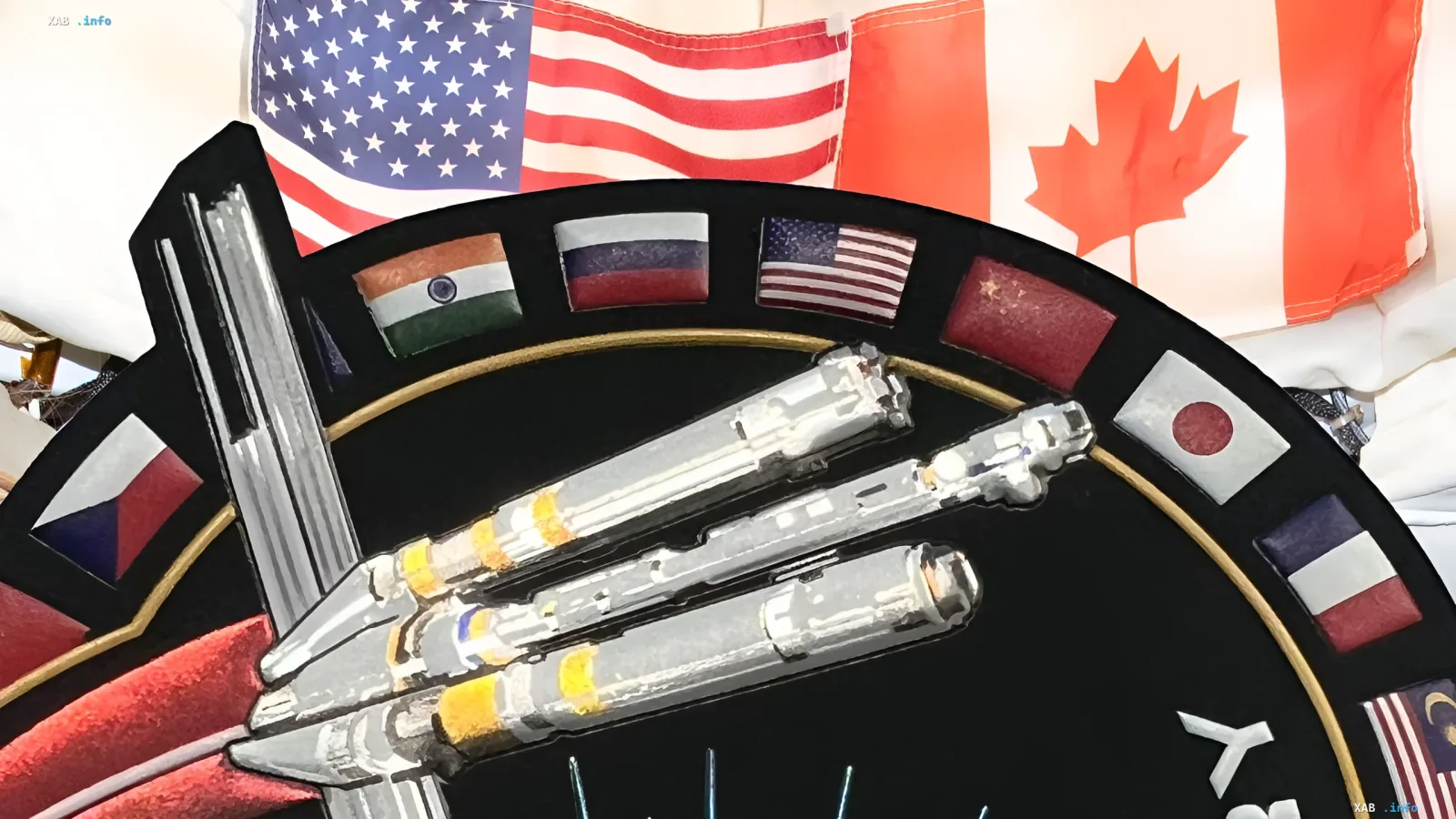
In the film version, the story with the flags took on a far more sweeping character. For a movie whose plot tells of an international expedition, the creators developed a patch featuring a spacecraft and the flags of 17 participating countries. The use of each flag required separate permission, and some states additionally insisted on controlling which flags their own flag ended up next to. As a result, clearing the final design took several weeks — a timescale disproportionate to the scale of the very detail that a viewer on screen may not even have time to notice.
A Reduced Set of Flags
Particular attention should be paid to the fact that for the sold and promotional versions of the patch, the number of flags had to be cut. Russia, India, and China were removed from the final composition, whereas the original working version of the patch included a significantly larger number of states — among the marks visible on screen are, in particular, the flags of India, Russia, the United States, China, Japan, France, and Malaysia. Thus, the diplomatic epic over one small piece of prop ultimately affected which countries 'appear' in the final image of the expedition.
Contradictory Data
The available materials contain inconsistencies that should be honestly pointed out. First, the film appears under different titles: in one place it is called 'Project Awe Maria,' in another — 'Project "Doomsday"', while both refer to the same project with a 17‑flag patch. Second, the number of flags on the patch is not fixed: the working version lists 17 countries, whereas in the commercial and promotional versions the composition is reduced, which creates a discrepancy in the figures when the 'overall patch' is mentioned. Both versions coexist in the sources, and there is no single unambiguous number of flags for all versions of the patch.
The outcome of this story is paradoxical and, in a way, ironic: humanity is capable of sending people to record distances from Earth and of shooting a blockbuster about saving civilization, yet it is unable to avoid the routine clearance of flag order. Space remains space, and bureaucracy, as the experience of both 'Artemis II' and the film industry shows, finds its way everywhere — all the way down to a tiny detail that most viewers will never have time to notice.