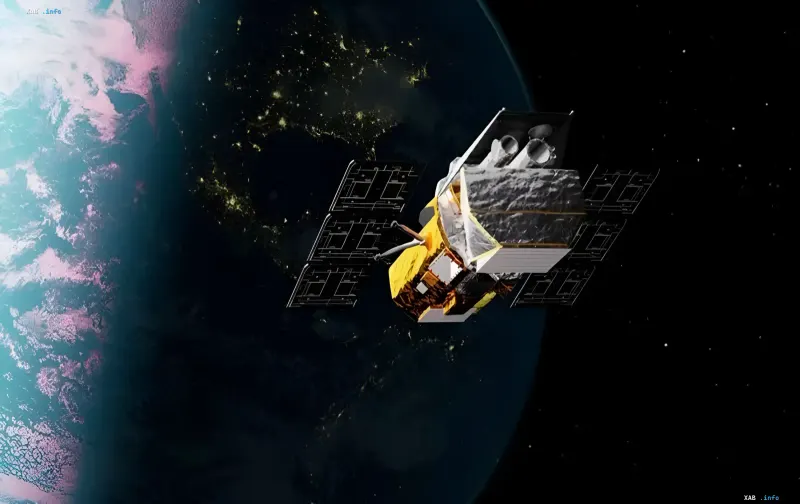
The National Aeronautics and Space Administration (NASA) and Katalyst Space Technologies have officially announced the cancellation of the mission to rescue the Swift gamma-ray telescope. The specialized rescue spacecraft Link, launched on July 3, 2026, was intended to capture the aging observatory using three robotic manipulators and electric thrusters, raising it to a safer orbit. However, in late July, the spacecraft suddenly lost stability and began to spin uncontrollably, making the primary mission objective impossible to achieve. Thus, one of the most ambitious on-orbit satellite servicing operations ended prematurely.
Timeline of failure: from launch to loss of control
According to Katalyst Space Technologies, the immediate cause of the incident was the failure of two of the three reaction wheels in the Link spacecraft's attitude control system. Simultaneously, malfunctions were detected in the compressed gas thrusters. The low-thrust plasma engines, which were supposed to compensate for the failure, could not fully restore control over the satellite's orientation. Prolonged issues with the control system led to the conclusion that the spacecraft was physically incapable of capturing the telescope and altering its orbit, after which the mission was deemed failed and cancelled.
Technical reasons for the failure
Experts point to a combination of several factors: the failure of inertia reaction wheels, which are a key element of precise orientation in weightlessness, and unstable operation of gas-dynamic thrusters. Low-thrust plasma engines, while capable of long-duration maneuvering, are not designed for rapid recovery of control after a loss of orientation. As a result, the spacecraft was unable to maintain the necessary position relative to the target, which is critical for the rendezvous and capture operation. Engineers emphasized that further attempts to maneuver would have carried the risk of total loss of the spacecraft.
The fate of the Swift telescope: a countdown
The Swift gamma-ray telescope is not equipped with its own thrusters for orbit correction and is gradually slowing down in the upper layers of Earth's atmosphere. Because of this, its descent is irreversible: the observatory is expected to burn up in the atmosphere at the end of 2026. This means that the unique tool for studying gamma-ray bursts and other phenomena in the Universe will cease operations due to natural causes rather than an accident. The loss of Swift will be a significant event for the astrophysics community, as the spacecraft has contributed to the study of cosmic cataclysms for many years.
Risks and record assembly timelines
The rescue mission was initially characterized as an operation with a high level of risk. Engineers managed to assemble and prepare the Link satellite in just nine months instead of the usual several years required for such spacecraft. Such a compressed schedule was driven by the desire to succeed before the irreversible orbital decay of Swift began. As experts note, it was precisely the record timelines and the aggressive approach to risk that laid the foundation for the current situation: the spacecraft was launched into orbit without a full cycle of long-term testing, which ultimately manifested as a failure of the attitude control systems.
A second wind for the Link spacecraft
Despite the failure of the primary operation, specialists do not intend to write off the Link spacecraft completely. It is planned to use it to test rendezvous technologies in space: the satellite will attempt to approach the Swift telescope to demonstrate the operation of navigation systems. Thus, even in a failed mission, practical benefits will be derived — data on the operation of targeting and control systems under real conditions of rendezvous with a stationary object in orbit, which is important for future satellite servicing operations.
Response from NASA and Katalyst leadership
NASA Administrator Jared Isaacman stated that the agency must be ready to act quickly and take reasonable risks when the potential return is worth it, emphasizing that this was the approach applied to this mission. Katalyst CEO Gonghee Lee noted that the company is proud of the interim results achieved and is using the experience gained to develop instructions for upcoming on-orbit satellite servicing. NASA Astrophysics Division Director Sean Dolan-Goldman added that the creation, testing, and launch of the mission in record time has already made a significant contribution to the development of US space infrastructure. Either way, the cancellation of the Swift rescue became an important precedent in the history of commercial on-orbit servicing operations.