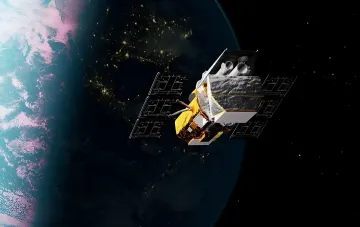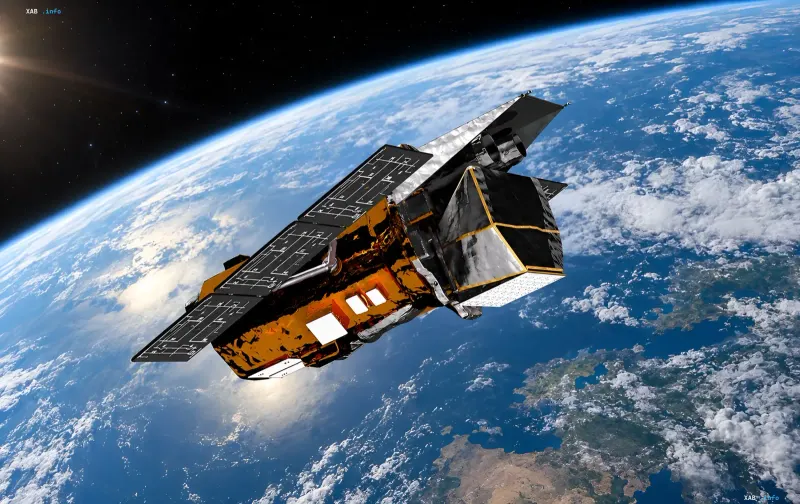
NASA has officially announced the conclusion of the mission for the Swift orbital observatory, one of the most productive scientific instruments in the history of space research. According to agency representatives, the telescope recorded its final scientific data on October 20, 2026. The spacecraft's entry into the dense layers of Earth's atmosphere is expected within the next few weeks, after which Swift will completely burn up. Scientists have monitored the observatory's orbital position for a long time because atmospheric drag caused the spacecraft to steadily lose altitude, and it lacked its own engines for orbital correction.
Failed Rescue Attempt: LINK Spacecraft Loses Control
An attempt to extend Swift's life was undertaken on a commercial basis. In September 2025, NASA awarded a $30 million contract to Katalyst Space Technologies to develop and launch the LINK rescue spacecraft. The mission launched on July 3, 2026: LINK successfully approached the observatory to a distance of 12–15 kilometers and captured a series of photographs. However, during the final phase of the maneuver, the spacecraft encountered serious technical failures—the attitude control thrusters and reaction wheels failed. LINK lost control and began spinning uncontrollably. On September 25, 2026, the rescue spacecraft itself deorbited and burned up in Earth's atmosphere, failing to complete the task of boosting Swift to a higher orbit.
Twenty Years on the Frontline of Astrophysics
The Swift telescope was launched into orbit in November 2004 with a single purpose—to detect and study gamma-ray bursts, the most powerful explosive events in the universe. The project was originally designed for a two-year operational life, but the spacecraft served for over two decades, vastly exceeding its projected lifespan. During this time, the observatory accumulated an unprecedented archive of observations that, according to the scientific community, will provide researchers with material for new discoveries for many decades to come. In 2018, the observatory was officially renamed the Neil Gehrels Swift Observatory in honor of Neil Gehrels, the mission's first principal investigator, who passed away a year earlier.
What's Next: Data Archive and Preparation for Atmospheric Re-entry
Although the physical existence of the spacecraft in orbit is coming to an end, Swift's scientific value is not zeroed out. The vast array of data collected over 20 years remains publicly accessible and continues to be used in research. NASA and partner institutions are monitoring the descent trajectory to determine the exact coordinates and time of atmospheric entry. Swift is expected to pass through the dense layers of the atmosphere and completely break up in the coming weeks, concluding one of the most enduring and productive missions in the history of American spaceflight.