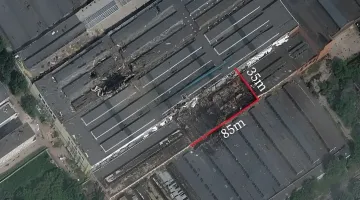
August 15, 2026, marked a turning point for Russia's space and military infrastructure. Ukrainian defense forces carried out a large-scale operation during which the latest FP-5 'Flamingo' cruise missiles delivered a critical blow to a strategic enterprise deep in Russia's rear. The target of the attack was the Rocket and Space Center (RSC) 'Progress' in Samara — a key plant responsible for assembling 'Soyuz-2.1b' launch vehicles, which form the backbone for launching military satellites and the 'Rassvet' communication system.
Precision Strike on the 'Heart' of Rocketry
According to OSINT analysts and specialized sources such as Defense Express, the strike was delivered with surgical precision. The missiles hit not just the perimeter of the plant, but a specific building: Building 106A. This is a specialized workshop for onboard electronics, where cable networks, control instruments, and printed circuit boards are assembled. In effect, Ukrainian forces destroyed the 'nervous system' of the 'Soyuz' family of rockets.
The destruction of this facility delivers a blow that could prove fatal to Russia's production capabilities. Amidst strict Western sanctions, Russia is facing an acute shortage of electronic components. Imported chips and parts are purchased individually through complex gray-market schemes. The loss of finished boards and unique assembly equipment will paralyze rocket production for months, and possibly years, as restoring such specific lines under conditions of isolation is practically impossible.
Synchronized Strike on Hypersonic Complex
The attack on Samara was not an isolated event. As confirmed by President Volodymyr Zelenskyy and the General Staff of the Armed Forces of Ukraine, this was part of a coordinated operation to destroy key defense industry objects deep in the rear. Simultaneously with the strike on RSC 'Progress' (located 900 km from the border), 'Flamingo' missiles hit the 'Savasleika' military airbase in the Nizhny Novgorod region.
At the airbase in the Nizhny Novgorod region, a hit on the maintenance infrastructure for MiG-31K interceptors was recorded. These fighters are carriers of the 'Kinzhal' hypersonic missiles, which Russia actively uses in the conflict. The synchronization of the strikes demonstrates the ability of the Ukrainian Defense Forces to strike targets at enormous distances, coordinating actions to inflict maximum damage on the enemy's military potential.

Official Reaction and Scale of Consequences
The Russian side was forced to admit the scale of the incident. Vyacheslav Fedorishchev, the Governor of the Samara region, in his morning address officially confirmed that the region had been subjected to a missile attack and 'damage to an industrial enterprise was recorded.' Attempts by Russian public channels to pass off the arrival as 'falling debris' were quickly refuted by eyewitness videos, on which the sound of a jet engine and a colossal explosion are visible.
The loss of the electronics workshop strikes at the most vulnerable point of 'Roscosmos'. RSC 'Progress' is the only plant in Russia providing serial assembly of rockets of this class. Without them, the Russian Ministry of Defense loses the tool for deploying reconnaissance satellites that coordinate strikes against Ukraine. Furthermore, the attack jeopardizes the ambitious broadband satellite communication project 'Rassvet' (analogous to Starlink), as funding loses meaning without the means to deliver payloads to orbit.
Contradictory Data
While the Ukrainian side and independent sources confirm the destruction of the electronics workshop, there are discrepancies in assessing the full scale of the damage. On one hand, the Ukrainian General Staff reports 'critical, hard-to-replace damage' and a de facto freeze of production. On the other hand, Russian official sources, while acknowledging damage to the enterprise, continue to use euphemisms, not revealing details about the degree of equipment destruction inside Building 106A. It is currently unknown whether the assembly lines were completely destroyed or if some equipment was saved; however, the mere fact of a hit on such a narrow point is already a strategic victory for Kyiv.