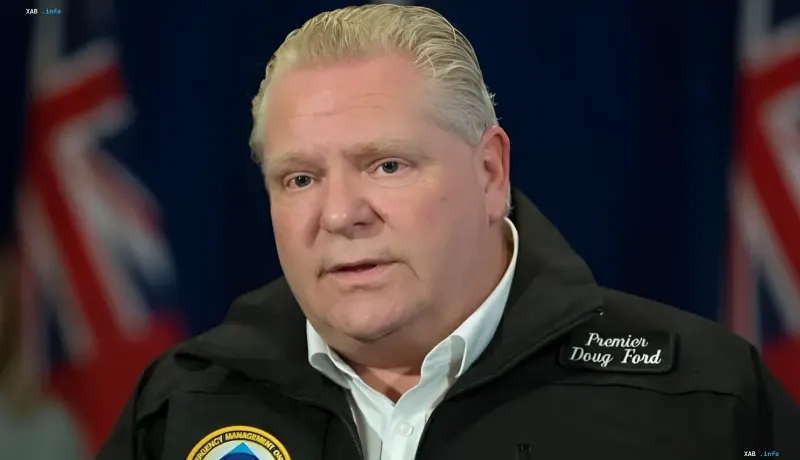
On August 22, 2026, prohibitive 50-percent US customs duties on Canadian exports worth approximately $20 billion took effect, effectively marking the collapse of bilateral trade negotiations that, according to Canadian authorities, had been in the final stage of agreement. Ottawa's response was immediate: Prime Minister Mark Carney announced the introduction of mirror tariffs on American goods effective September 8, 2026. Against this backdrop, Ontario Premier Doug Ford issued a public statement characterizing Washington's negotiating tactics as systemically unpredictable, which triggered a wide resonance in North American media.
Chronology of the Tariff Escalation and the Regulatory Framework
The trade confrontation between the two largest economies in North America is not a one-off event. According to RFI, as early as October 2025 the Trump administration had raised duties on Canada by 10 percentage points, citing the publication of an advertisement featuring a quote by Ronald Reagan, which points to a months-long dynamic of tightening tariff policy. By July 2026, according to a report by the First Channel agency, Prime Minister Carney had publicly stated his intention to "intensify trade negotiations in the coming weeks," indicating that the formal negotiation track was still intact. However, by August 22, 2026, that track was severed by the introduction of 50-percent duties covering key export categories: raw materials, metals, automotive components, and energy carriers. The legal framework of the conflict rests on the renegotiation of the terms of the United States–Mexico–Canada Agreement (USMCA/CUSMA), under which Washington is demanding changes to rules of origin and protection of the domestic labor market — provisions that Ottawa classifies as a violation of the principle of reciprocity enshrined in the current version of the agreement.
Macroeconomic Consequences and Vulnerable Sectors
A full-scale exchange of 50-percent tariffs creates an asymmetric but mutually destructive economic effect. For Canada, the most vulnerable is the industrial cluster of the province of Ontario — automobile manufacturing, metallurgy, and machinery building, whose production chains are inextricably linked to the Detroit–Toronto–Hamilton automotive corridor. For the US, rising costs of imported components are passed on to the American auto industry and retail trade, generating inflationary pressure on the end consumer. According to estimates by Canadian analysts, a halt to assembly lines on both sides of the border, if the tariff barrier persists for more than two quarters, could lead to a reduction in Ontario's GDP by 1.5–2.5 percentage points on an annual basis. In response, Ontario provincial authorities are preparing an emergency package of measures: compensation payments to car plants, temporary suspension of provincial environmental fees for industrial enterprises, and subsidies for logistics chains.
Provincial Positions and Federal Consolidation
Doug Ford's speech on August 22, 2026 went beyond rhetorical criticism. In a special letter to Prime Minister Carney, the head of Ontario called on the federal government to adopt an uncompromising stance, formulating the principle that "no deal is better than a bad deal imposed by blackmail." This statement reflects a broader trend toward consolidation of positions among Canadian provinces within the so-called "Team Canada," when regional governments, whose budgets directly depend on export revenues, pressure Ottawa to prevent unilateral concessions under deadline pressure. For Ontario, whose industrial exports to the US make up a significant share of provincial GDP, a concession on rules of origin would have meant a de facto loss of competitiveness of Ontario plants in the US domestic market without adequate compensation.
Contradictory Data
In verifying Doug Ford's quote, a discrepancy was found in the translation of the original idiom. In English-language primary sources (Politico, Canadian federal and provincial media), the Ontario premier is quoted with the phrase "lunch money" — "money for school lunch," whereas in a number of Russian-language retellings (including aggregator publications) this phrase is rendered as "pocket money." The semantic difference is minor, however, for factual accuracy one should rely on the original: the reference is specifically to "lunch money." In addition, the RFI source (October 2025) records a 10-percentage-point duty increase on a different occasion (an advertisement featuring a Reagan quote), which is a separate episode of tariff escalation and is not identical to the introduction of the 50-percent barriers on August 22, 2026. Conflating these two events in a single narrative could distort the chronology and scale of the restrictions.
Long-Term Prospects and Institutional Risks
If the mirror tariffs of September 8, 2026 take effect without prior diplomatic de-escalation, the North American trade architecture built under the USMCA will be subject to structural review. For Canada, this means the need to diversify export flows toward Asia and the EU, which requires capital investment in infrastructure and a restructuring of production chains on a 3–5 year horizon. For the US — rising costs in the automotive and metallurgical sectors, which depend on Canadian components. The institutional risk lies in the fact that a unilateral renegotiation of the agreement's terms without the consent of the other party creates a precedent that undermines trust in multilateral trade frameworks in the region. In a situation where provincial governments, above all Ontario, are publicly registering their readiness for a "protracted economic siege," the probability of a swift return to negotiations by the end of 2026 is assessed by analysts as low.