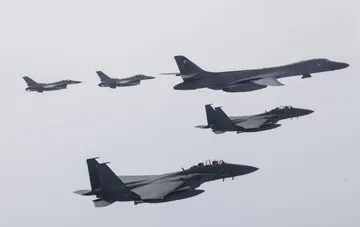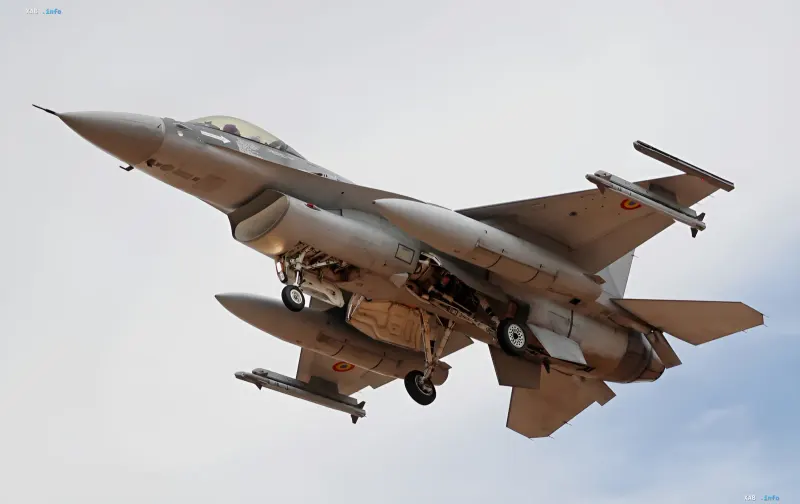
American startup Castelion has received a contract modification from the US Air Force Research Laboratory (AFRL) to begin work on integrating the Blackbeard hypersonic missile onto the F-16 fighter jet. The company announced this on October 26 on social media platform X, stating: «Castelion has received a modification to our ongoing Air Force Research Laboratory contract to begin integrating Blackbeard with the F-16. We are grateful to the Air Force for their trust.» AFRL has not commented on the contract modification, and the company has not disclosed the cost of the work, its timeline, or the date of a potential first test launch from an F-16.
A Missile Harder to Intercept Than a Ballistic One
Blackbeard is designed for speeds exceeding Mach 5 and atmospheric maneuvering, making it significantly harder to intercept than a ballistic missile following a predictable trajectory. Castelion's strategy is built on mass and relatively low-cost production: founded in 2022 by former SpaceX engineers and headquartered in Torrance, California, the company is building a facility in Rio Rancho, New Mexico, with a design capacity of 500 missiles per year. This combination of hypersonics, maneuverability, and low unit cost is what makes the project attractive to multiple branches of the US military.
Contract History: From $16.4 Million to $37.2 Million
The new modification is not the first in Castelion's work with the Air Force. In September, AFRL increased the value of an existing contract by $16.4 million to $37.2 million; the contract pertains to an affordable long-range cruise/serially produced missile and runs through June 2028. Castelion did not specify whether the fresh modification applies to this specific contract. The company had previously worked on Blackbeard for the US Navy, and it is the naval branch that has been driving the program most actively.
Navy, Army, and Now Air Force: Three Platforms for One Missile
In April, the US Navy allocated $105 million to integrate Blackbeard onto the F/A-18E/F Super Hornet and conduct combat testing in the Indo-Pacific region. In June, 50 missiles were ordered for early operational capability, in August nearly $90 million was allocated to transition the missile into a formal program of record including features designed to accelerate foreign military sales, and in September the first serial production order worth up to $200 million for 444 missiles was placed. Separately, in October 2025, the US Army received a contract for a ground-launched version of the missile utilizing the HIMARS launcher. Thus, the F-16 becomes the third major platform after the Super Hornet and the ground system.
Why the F-16 and What It Means for Export Versions
The F-16 is significantly more widespread than the Super Hornet: it is the most numerous fighter jet in the US Air Force and is also operated by over two dozen other countries. Castelion did not state whether current work covers export variants of the F-16, but the very choice of this platform underscores a bet on mass armaments rather than a narrow naval footprint. Against this backdrop in Ukraine, where F-16s are already entering service, discussions are ongoing regarding both air-to-air missile shortages and Lockheed Martin's proposal for a special fighter variant featuring an AESA radar and extended range—making the integration of new weaponry onto the F-16 an especially sensitive topic for US allies.