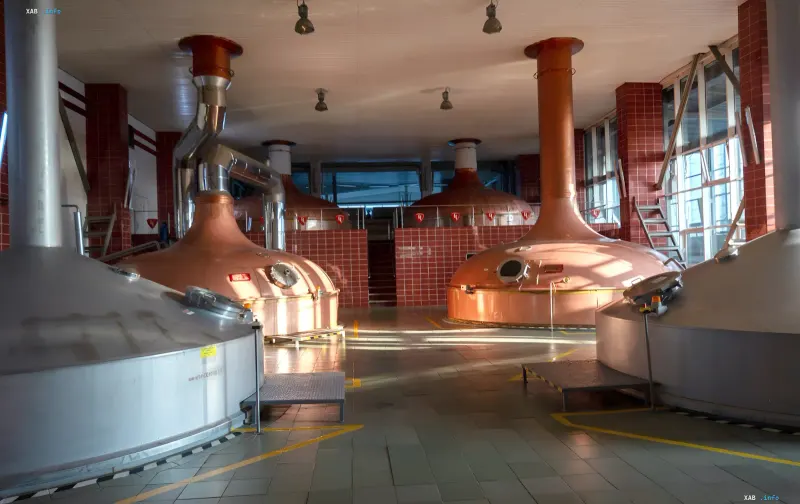
'Is your beer made from powder?' According to Larisa Akulinova, brewing production manager at AB InBev Efes Ukraine, brewery workers hear this question even during factory tours. Visitors accustomed to simplified explanations from domestic folklore are often surprised when they first see rows of copper mash and brew kettles, pipeline systems, and yeast fermenters in person. In an interview with Wave RBC.UA, Akulinova systematically dismantled four persistent myths about beer production that, in her observation, still live on in the mass consciousness of consumers.
Powdered beer: Where the myth came from and what actually happens
The first and perhaps most widespread misconception is the idea that beer is 'made from powder' by diluting it with water to the desired consistency. Akulinova directly called this statement a myth. The real technological cycle begins with the preparation of wort—a sweet liquid obtained by extracting sugars from sprouted and dried malt. Next, the wort is sent to the brew kettle where hops are added, after which it enters the fermenters. It is in the fermenters that yeast is added to the wort, and fermentation begins—a biochemical process during which microorganisms process sugars. The finished drink is thus the result of a complex multi-stage production cycle, rather than 'dissolving a dry concentrate.'
Alcohol is not added—it is born in the fermentation process
The second myth, which Akulinova considers outdated, is the belief that 'alcohol is added' to beer to achieve the necessary strength. According to her, alcohol in beer is formed exclusively as a byproduct of natural fermentation: yeast processes available sugars, and ethanol appears as a result of this metabolic process. 'It is not added, it is the result of natural fermentation,' the expert emphasized. If a producer needs to obtain a stronger variety, they do not resort to adding ready-made alcohol, but adjust the recipe: they increase the amount of sugars that the yeast can process during fermentation. Thus, the strength of the beer is laid down at the stage of malt selection and mashing regime setup, rather than at the final stage of 'alcohol boosting.'
Color does not equal strength: How malt paints the palette of varieties
The third myth, still found in everyday discussions, is the certainty that dark beers are necessarily stronger than light ones. Akulinova explained that the color of the drink is determined primarily by the malt and the method of its preparation. Barley is sprouted and dried; for light malt, drying takes place at relatively low temperatures and takes less time, whereas for dark malt, the holding time is extended and the temperature is raised, causing the grain to acquire a characteristic brown, sometimes almost black shade. Strength, however, depends on completely different parameters: the amount of malt in the recipe and the features of the fermentation process itself. Consequently, it is impossible to reliably determine the alcoholic strength of beer by its color alone—a light lager can be stronger than a dark ale, and vice versa.
Hops and 'female hormones': What the cones actually contain
The fourth myth, which Akulinova called 'particularly persistent,' is related to the idea that men who regularly consume beer allegedly receive 'female hormones' from it and can 'turn into women.' The expert suggested that the root of this misconception lies in hops: brewing traditionally uses the cones of female hop plants (Humulus lupulus). Indeed, hops contain phytoestrogens—plant compounds with estrogenic activity. However, as Akulinova emphasized, phytoestrogens are not identical to human sex hormones: their molecular structure and mechanism of action are fundamentally different from estrogens produced by the human endocrine system. Therefore, the claim that beer is able to 'reprogram' a man's hormonal background has no biological basis.
The analysis of these four myths, conducted directly at the production facility, clearly demonstrates how far modern brewing has come from domestic perceptions of it. Copper brew kettles, yeast fermenters, and precise control of temperature and fermentation time have turned beer production into a discipline where every parameter—from the degree of malt roasting to the density of the yeast slurry—is subject to strict technological regulations. And, as the practice of AB InBev Efes Ukraine tours shows, a personal look at this process is more effective than any texts at destroying established myths.