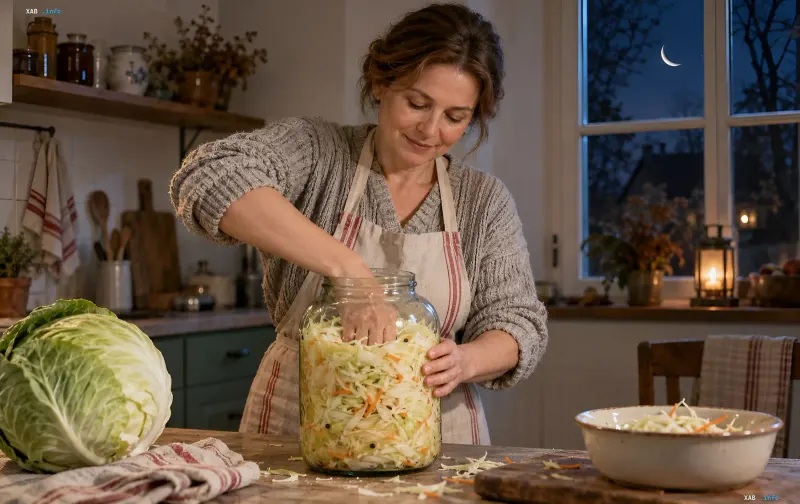
November is traditionally considered one of the most popular months for preparing fermented cabbage for the winter. By this time, late varieties of white cabbage reach maximum density and sugar content, making the preserve especially delicious and crunchy. Homemakers choose dense, heavy heads, hone recipes passed down through generations, and often check the lunar calendar to pick the most auspicious date. In November 2026, interest in home preserving remains high: the fermentation season coincides with cooling weather, meaning natural conditions for fermentation become optimal without the need for artificial temperature control.
Lunar Calendar: What Folk Traditions Say
According to established folk recommendations, the waxing Moon is considered the best period for fermenting cabbage. On these days, according to belief, the vegetable releases juice more actively, and the lactic acid fermentation process proceeds harmoniously, ensuring the crunch and aroma of the finished product. New moons and full moons, conversely, are considered unfavorable: the cabbage may turn out soft, excessively sour, and lose quality faster. In November 2026, homemakers relying on the lunar calendar traditionally avoid new and full moon days, shifting preparation to the waxing moon phase. It is important to emphasize that these beliefs are part of folk culture and have no confirmed scientific basis: the influence of lunar phases on the speed and quality of fermentation has not been proven in any available research.
“Men's Days”, Weather, and Mood: Omens Passed Down Through Generations
In folk traditions, significance was attached not only to lunar phases but also to the day of the week. There was a persistent sign that it is best to ferment cabbage on so-called “men's days” — Monday, Tuesday, or Thursday. It was also believed that dry and cool weather was preferable for preparation, while a sudden warming could negatively affect the fermentation process. Special attention is also deserved by the psychological aspect: our ancestors believed that cabbage “senses” the energy of the person preparing it, so they began work without quarrels or negative thoughts. All these observations form a colorful picture of home culinary culture, although from the viewpoint of fermentation biochemistry, completely different parameters play a key role.
Practical Rules: From Head Selection to Salt Concentration
Late varieties of white cabbage are best suited for fermentation. When choosing a head, focus is placed on density, weight, and juiciness of the leaves: the vegetable should not have rot, mold, or significant damage. For classical fermentation, 2–2.5% of salt relative to the mass of prepared cabbage is usually used, meaning 20–25 g per 1 kg. The exact amount varies depending on the specific recipe and personal preferences. At the start of fermentation, a temperature of about 20–22 °C is maintained unless the recipe implies a different regime. Cut vegetables must remain submerged in brine to reduce the risk of spoilage and the development of undesirable microflora. As indoor temperatures drop, fermentation slows down, which helps preserve product quality throughout long storage.
Folk Wisdom and Scientific Approach: Where the Boundary Lies
Lunar calendars and daily omens remain a living element of household culture and continue to inspire millions of people worldwide. However, experts in food biochemistry are unanimous: the final taste, crunch, and shelf life of fermented cabbage are directly influenced by the variety and freshness of the raw material, precise salt concentration, temperature and duration of fermentation, and process hygiene. The lunar calendar can be viewed as a convenient planning tool and a source of enjoyment from the ritual, but not as a mandatory technological condition. Combining respect for traditions and adherence to proven fermentation rules allows you to obtain a preserve that will delight both with taste and confidence in its quality all winter long.